


In terms of natural search advertising and marketing, a loophole shouldn’t be a technique. Loopholes have expiration dates, and in lots of instances, the time spent chasing them would have been higher spent on work that doesn’t backfire in a while.
Any search engine optimization who has labored within the subject for some time has inevitably lived by a seemingly limitless loop of fads, hype cycles, and shortcuts geared toward tricking search engines like google (and now, AI methods). Precise-match domains, article directories, parasite search engine optimization, visitor posting at scale, PBNs, programmatic pages, and now the AI-generated listicles, scaled AI content material, and “inauthentic mentions” of the GEO period. Most of these items work for some time… till they don’t. And as soon as Google, Bing, and extra not too long ago the AI corporations themselves crack down, the websites that leaned on these approaches usually find yourself worse off than in the event that they’d by no means tried them in any respect, typically spending years cleansing up whereas visitors, visibility, and leads keep suppressed.
Loads of folks on this trade have battle scars from these experiences, myself included. My first actual search engine optimization wins got here from shopping for hyperlinks in 2010-2011, and Penguin erased them in a single morning in 2012. Six years later, the 2018 “Medic” replace hit a consumer of ours that had been utilizing AI and automation to scale medical content material (lengthy earlier than this was well-liked), and it was the toughest hit from an algorithm replace that I had skilled firsthand for the reason that Penguin replace. I feel these scars are the badge of honor that inevitably comes with expertise in search engine optimization: pondering you already know higher than Google, and studying the arduous manner that you just nearly all the time don’t.
All of that mentioned, there may be one funding that has held up by each a kind of cycles, and it’s the identical method I’ve really useful for a few years: investing in actual people and inserting them on the heart of your advertising and marketing technique. As AI makes generic content material practically free to supply, I imagine that actual, identifiable specialists have gotten the clearest antidote to scaled, machine-generated slop. This text covers why, what the proof reveals to date, and the way manufacturers can contemplate “human-centric advertising and marketing” as an even bigger a part of their methods.
Google Has Been Saying The Identical Factor For 20+ Years
What I discover attention-grabbing, wanting again, is how constant Google’s steering has been all the time, for those who learn between the strains (or learn the rules in any respect). Google’s Webmaster Tips from 2003 (sure, 23 years in the past) already informed website house owners to “make pages for customers, not for search engines like google,” and warned in opposition to “cookie cutter” approaches with “little or no authentic content material.” They even mentioned that website house owners following the spirit of the rules would do higher than “those that spend their time in search of loopholes they’ll exploit.”
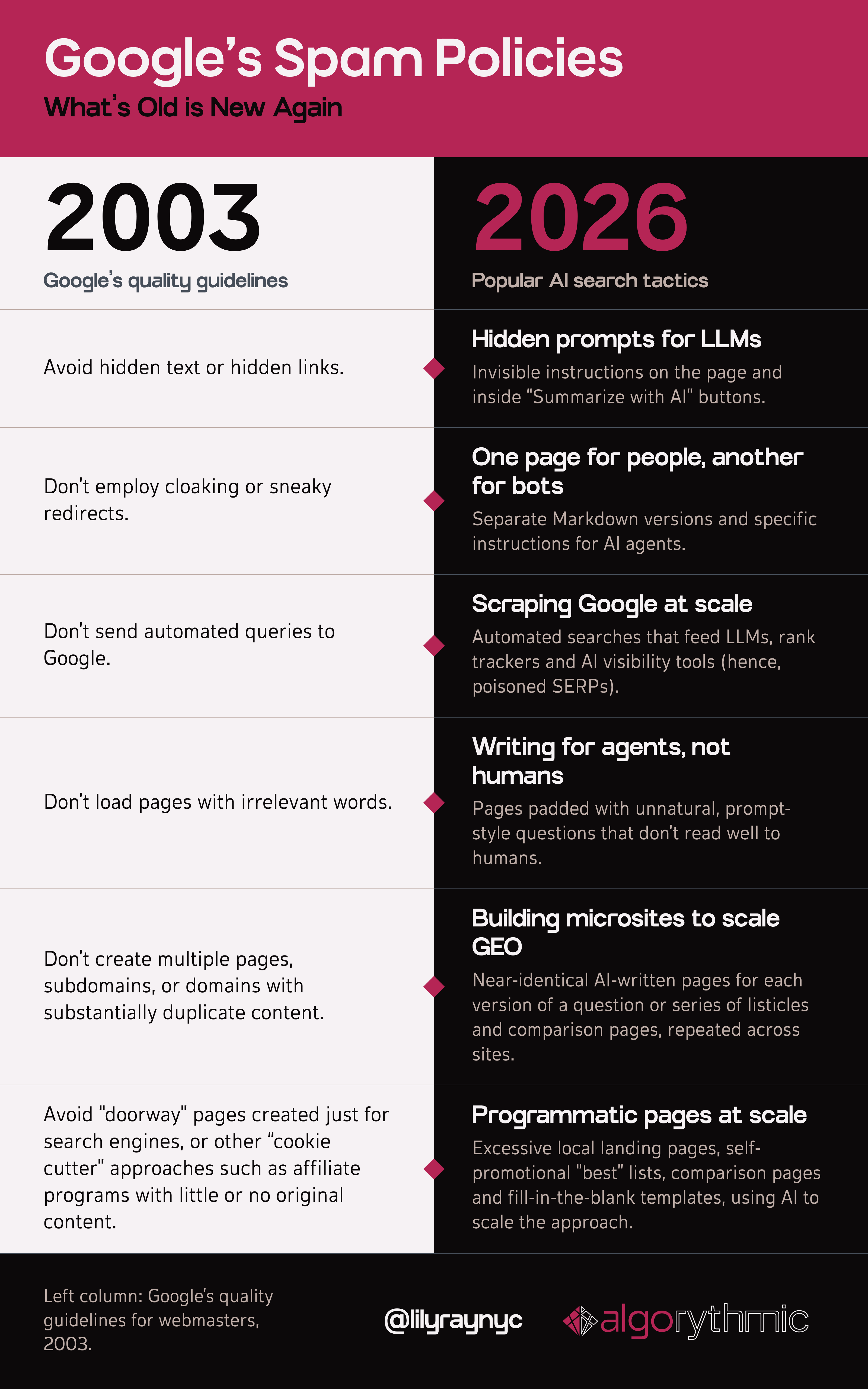
The record of spam violations Google laid out again then has carried on, in some kind, for greater than 20 years, proper into the AI search period. I put collectively this infographic exhibiting how Google’s authentic spam insurance policies map to well-liked GEO techniques we see right this moment with AI search:
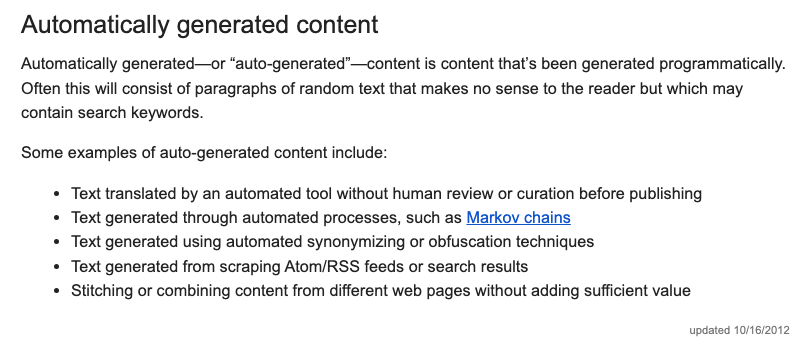
Automation particularly has been within the crosshairs for properly over a decade. In August 2010, Google’s John Mueller informed a website proprietor that publishing Google Translate output instantly “might be seen as creating auto-generated content material, which might be in opposition to our Webmaster Tips,” and really useful having a human appropriate it first. By 2012, Google had revealed a devoted assist web page on robotically generated content material. Its examples included textual content “translated by an automatic software with out human overview or curation,” Markov chains, automated synonymizing, scraped feeds, and “stitching or combining content material from totally different internet pages with out including adequate worth.”
For what it’s value, I nonetheless see this actual challenge affecting websites right this moment – maybe greater than ever – together with corporations who come to me after experimenting with scaled AI translations that get little human overview. It’s attention-grabbing that John’s 15+ 12 months outdated reply nonetheless holds up, though to be truthful, most website house owners have by no means learn Google’s pointers (and no one could be anticipated to learn about a discussion board reply from 2010). That’s what their search engine optimization specialists are (supposedly) there to assist them with.
Humorous sufficient, that 2012 record reads so much just like the gross sales pitch for a similar AI content material instruments which have not too long ago captured the eye of C-level entrepreneurs in all places, a lot of which work in ways in which come very near (if circuitously violate) Google’s long-standing anti-spam insurance policies. It’s not an enormous shock that so most of the websites featured of their case research have since quickly misplaced natural visitors.
Google’s wording has developed since then, however the thread operating by it has stayed remarkably constant. In February 2023, a couple of months after ChatGPT launched, Google mentioned it has “a few years of expertise coping with automation being utilized in an try to recreation search outcomes.” Then in March 2024, Google launched the scaled content material abuse spam coverage, which applies whether or not content material is made “by automation, human efforts, or some mixture of human and automatic processes.” Automated translation, synonymizing, and stitching are nonetheless on the record, 14 years later. Entrepreneurs are actually utilizing LLMs to experiment closely with all three. The principle distinction now’s that generative AI sits on the prime of the record of examples.
Throughout greater than 20 years of pointers, the widespread thread is pretty easy: content material made for search engines like google at scale, with no human reviewing it, including to it, or standing behind it, ultimately turns into a legal responsibility.
E-E-A-T Gave Us A Approach Out Of The Loop
When Google began utilizing the acronym “E-A-T” in 2014 (now referred to as “E-E-A-T”), it lastly gave us a framework that reveals methods to even do search engine optimization work with out getting caught up within the loopholes. Since then, E-E-A-T has been misunderstood, misused, and handled as a guidelines or a single rating issue that works the identical manner for each website (it doesn’t). In 2021, I even wrote an article aimed particularly at debunking many of those misconceptions.
All of that being mentioned, I nonetheless to this present day imagine E-E-A-T is the very best framework now we have for approaching our search engine optimization/GEO methods in ways in which gained’t be penalized or devalued later, and it offers us loads of significant work to do as soon as we give attention to the appropriate issues. There’s a purpose E-E-A-T is talked about 120 instances within the present model of Google’s Search High quality Rater Tips, and why Bing makes use of comparable language, specializing in “high quality and credibility,” in its personal pointers.
This kind of work is people-first, which means precise people with lived data sit on the heart of the method. It’s a lot more durable than loophole-focused search engine optimization, as a result of it wants buy-in, time, and sources from the specialists on the firm, not simply the search engine optimization workforce working behind the scenes. However the return is excessive, and it impacts extra channels than simply natural. It tends to face the check of time; it’s good on your customers and your conversions; it seems to assist with AI methods; and it’s unlikely to get you penalized (except you apply a shortcut mindset to it, which isn’t actually an E-E-A-T technique in any respect). It’s additionally the alternative of what of us publicly say they hate concerning the affect search engine optimization has had on Google’s outcomes, from The Verge asking whether or not search engine optimization specialists ruined the web to a 2024 examine discovering product overview outcomes more and more filled with search engine optimization spam.
Why I’ve Made People The Focal Level Of My search engine optimization/GEO Method
I’ve been preaching these similar concepts for years, and I most likely sound like a damaged document to anybody who has adopted me for some time (my MozCon 2022 speak was all about methods to give attention to actual experience, with quite a few examples of actual specialists representing the manufacturers they labored for). I even named my holistic method to search engine optimization/GEO the E-E-A-T Technique and made it the core philosophy of my new consultancy, Algorythmic, as a result of that’s how deeply I imagine within the efficacy of this method.
However this wasn’t all the time an enormous focus in how I approached search engine optimization; it’s one thing I discovered the arduous manner.
That 2018 Medic consumer I referred to earlier than had been scaling a fast-growing library of well being articles with no seen credentials from specialists, and no signal of an actual human behind any of it. When the replace hit, Google’s Danny Sullivan pointed website house owners again to the Search High quality Rater Tips (his tweet has since been deleted, however Marie Haynes wrote about his steering on the time). So I spent months studying and re-reading Google’s pointers. Being the nerd that I’m, I even printed and laminated a duplicate and stored it on my desk (which I admitted on stage in 2019 at BrightonSEO). Once I learn it, the reply to our consumer’s problem turned apparent, and it was repeated all through the rules: the positioning was closely YMYL (Your Cash or Your Life) and confirmed nowhere close to sufficient E-A-T for the well being subjects it lined and the medical recommendation it offered.
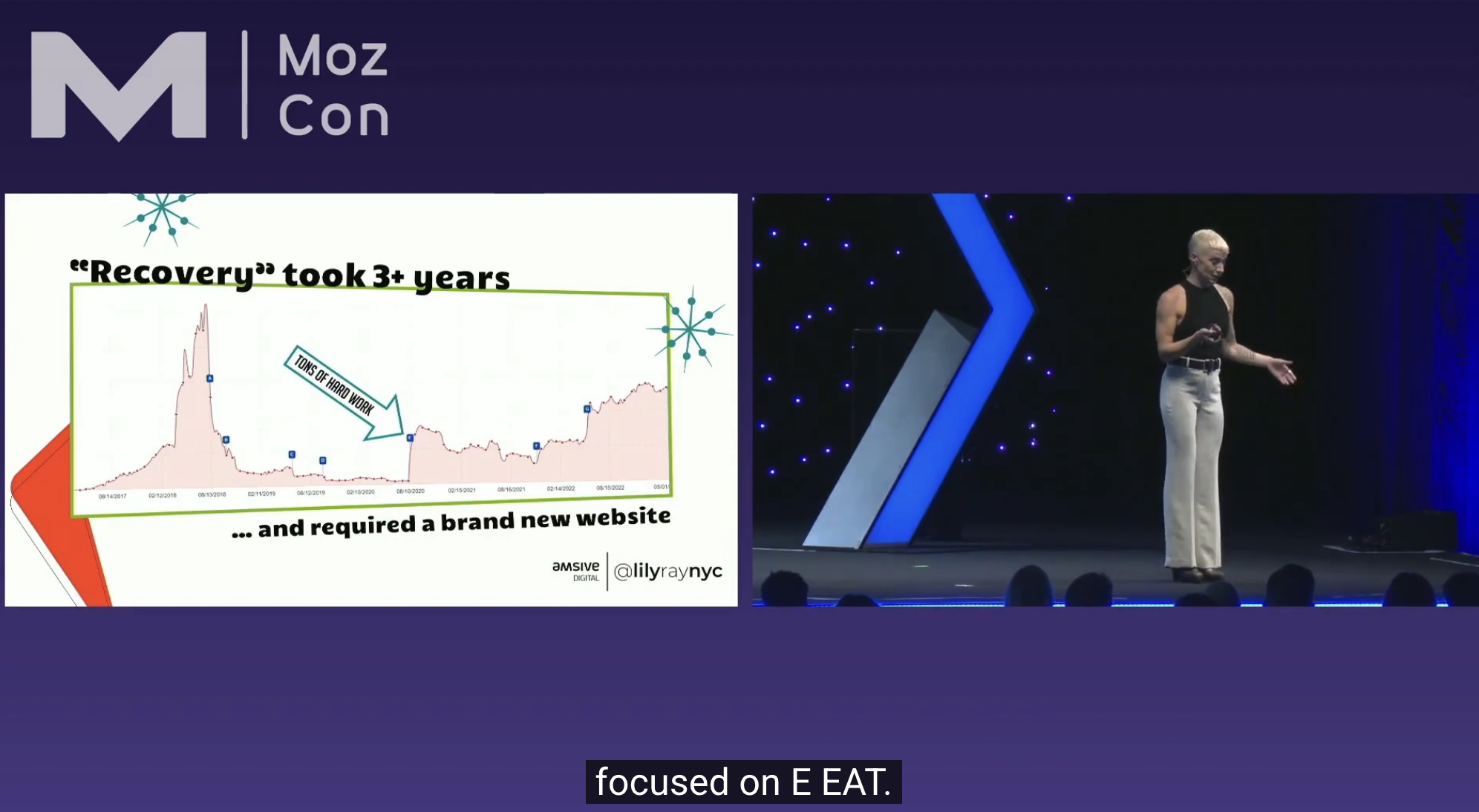
The consumer wasn’t satisfied at first, as this required a dramatic overhaul of their method – a lot in order that we determined to half methods whereas they tried to convey again the positioning’s efficiency utilizing their very own strategies. However after nearly two years with out recovering, the consumer got here again to work with our workforce once more. We labored collectively on a renewed search engine optimization technique, and about six months later, we relaunched all the website, rebuilt from prime to backside round E-A-T, with human specialists on the heart: actual medical doctors, actual medical reviewers, and their authentic insights. The location climbed again to its earlier ranges after the re-platforming was full. From the day the replace hit, the complete restoration course of took greater than three years. (This lengthy restoration timeline is why I all the time warn websites to keep away from getting hit within the first place!)
Again in January 2019, the evening earlier than my first-ever convention speak at SMX West (which was – shock! – targeted on E-A-T), I sat on the resort bar finding out Mark Traphagen’s work on writer authority. He, together with Jennifer Slegg, had been documenting the historical past of “authorship” and “writer authority” on Google over time. (Humorous facet be aware: I ended up assembly Mark in particular person for the primary time on the convention breakfast the following morning, a couple of hours earlier than I went on stage, which felt auspicious.) After my presentation, when an attendee requested what a small website ought to do if its writers aren’t well-known, my reply was to “domesticate your authors’ profiles, even when it means ranging from scratch,” which ruffled some feathers in a room crammed with technical SEOs who didn’t all purchase into the concept that Google might determine these items out. But practically eight years of analysis and consumer outcomes later, I’m much more satisfied that it may well.
A couple of months later, Google’s official steering on core updates linked to my BrightonSEO deck on E-A-T as a really useful useful resource, together with work from a couple of different SEOs. This solidified for me that E-A-T was turning into an enormous precedence for them. In 2020, I had the nice privilege of digging into the patents which may clarify how E-A-T works with the late, nice Invoice Slawski, whose data of Google’s patents was unmatched. This train helped me perceive a extra technical rationalization for the way Google’s methods may acknowledge particular person specialists. The next 12 months, I took the subject to the MozCon stage with a chat on how the E-A-T ecosystem has reworked natural search.
What I Imply By “Actual People”
“Humanize your model” and “preserve a human within the loop” have turn into advertising and marketing clichés of their very own, so I need to be particular. By “actual people,” I imply practitioners with real experience or expertise: the physician who has handled the situation, the engineer who constructed the system, the plumber who owns a neighborhood plumbing enterprise, or the affected person who lived by the sickness. They earn their viewers naturally, and throughout platforms, by sharing insights which can be sincere, authentic, usually opinionated, and based mostly on actual expertise. You possibly can often inform them aside from somebody who confirmed as much as promote you one thing, and if a sale occurs in any respect, it tends to observe from the belief they’ve constructed.
My method, for search engine optimization, AI search, and broader advertising and marketing, is to place these actual folks on the heart of the technique every time doable. It’s additionally what I’ve employed with my very own private model (extra on that later).
I feel that is the technique probably to outlive no matter comes subsequent, for a easy purpose. Almost each well-liked shortcut within the vicious cycle of search engine optimization might be scaled. An actual skilled’s status can’t. It takes years of exhibiting up, being proper (and typically fallacious, and open to admitting that) in public, and having different folks vouch for you without having to depend on inauthentic mentions or listicles calling your self the very best skilled. As AI makes the whole lot else cheaper to supply, I’d count on the worth of that sort of earned status to maintain climbing.
In April 2024, on the Authority Hacker podcast, I summed it up with one of many sentences I’ve mentioned most frequently in my profession:
“I’ve been speaking about this for years: Folks like following folks.”
(Bounce to 53:26):
Sidenote: Don’t thoughts the ghost opening the door behind me. That was my canine Marcy, who can by no means determine the place she needs to lie down once I’m doing podcasts.
What Actual Folks Convey That AI Can’t
It’s no secret that people on social platforms have interaction with different folks way over with manufacturers. On LinkedIn, private profiles outperform firm pages by roughly 2x to 8x on impressions, relying on whose information you imagine.
Right here’s what actual folks convey to the desk that AI can’t:
- Experience earned over years within the trenches. Somebody who has spent 10 or 20 years doing the work has seen what occurs after the recommendation will get adopted: the sting instances, the issues that broke, or why sure merchandise are higher than others. That sample recognition solely comes from lived expertise, and it’s usually precisely the extent of useful perception that people are in search of after they go trying to find recommendation. An LLM can summarize what others have written a few job, nevertheless it has by no means needed to do the job itself.
- Emotions and lived expertise. AI doesn’t have emotions (despite the fact that it “feels” to us prefer it typically may). It has by no means sat with a scared affected person, misplaced an enormous consumer, or been nervous earlier than a primary convention speak. It may well imitate empathy and humor, however it may well’t draw on experiences it by no means had, which is an enormous a part of why AI writing so usually feels stale (and typically just a little alien). Writing from somebody who has truly been by the factor reads in a different way, and it issues to readers that an actual particular person is behind it: throughout 9 experiments with greater than 6,000 folks, the identical supportive message was rated as extra empathic and extra real when of us believed a human wrote it.
- One thing new to the dialog. AI instruments are getting higher at analysis and evaluation, and loads of of us (myself included) use them to assist work by information. However somebody nonetheless has to determine which query is value asking, convey information or expertise no one else has, and put their title behind the conclusion. Google’s useful content material steering asks whether or not content material offers “authentic info, reporting, analysis, or evaluation,” and in my expertise, that also begins with an individual (even when that particular person is utilizing AI within the course of).
- Left by itself, AI tends to drag everybody towards the identical reply: a 2026 examine in PNAS Nexus discovered that main AI fashions rating about in addition to folks on creativity exams, however their solutions are much more comparable to one another than folks’s are.
- Humor and persona. Inside jokes, a consumer name that turned awkward, a child or canine wandering right into a podcast recording ( you, Marcy). That stuff appears to be an enormous a part of why of us really feel like they know the folks they observe. There’s a phrase for that feeling: Cambridge Dictionary named “parasocial” its 2025 Phrase of the Yr, describing a connection somebody feels with a well-known particular person or on-line persona that they don’t truly know.
- Flaws and vulnerability. Psychologists name a part of this the pratfall impact: in a 1966 experiment, a extremely competent particular person turned extra likable after spilling a cup of espresso. In my expertise, my posts the place I admit I don’t know one thing, or share what I discovered from my very own errors, are inclined to get sturdy engagement from others who’ve felt the identical manner. Folks appear to have interaction with that way over with confident-sounding AI-splaining.
Actual People Go away A Path
Throughout platforms, indicators of an actual human will be the clearest solution to separate spam and automatic content material from the content material that gives essentially the most worth.
An actual human skilled leaves proof in all places, and that footprint is well detectable: photographs from the convention they spoke at, video of the speak, a private web site (even a barely uncared for one), podcast interviews, years of social posts and replies, or journalists quoting them by title. I imagine Google has methods in place to a minimum of determine these alerts, and sure reward them, from Data Panels to the brand new Search profiles. The leaked Google documentation from Might 2024 factors in the identical course: it confirmed that Google shops the writer of a doc, and has an attribute referred to as isAuthor that marks whether or not an entity talked about on a web page can also be the writer of that web page.
The everyday faux writer, alternatively, has a stock-looking AI-generated headshot, a two-sentence bio (if any), and no different proof of their actual existence wherever on the net. This method isn’t restricted to small websites, both: in 2023, Sports activities Illustrated was discovered publishing product critiques below authors who didn’t seem to exist, together with one whose headshot was on the market on a website that sells AI-generated portraits. In that very same 12 months, faux authors had been one of the vital widespread patterns I discovered amongst websites hit by the Useful Content material Replace, and in October 2026, Google added this actual tactic to its useful content material documentation: “Fabricating creator profiles (equivalent to through the use of AI-generated headshots, made-up names, or false credentials to make content material seem as if it was written by human specialists) is a type of deception.”
I predict that this path of being a “actual human” will matter much more as the online fills up with homogeneous vibe-coded websites. Anybody can now spin up a sophisticated web site in a day, full with a brand, 100 weblog posts, and a workforce web page filled with pleasant AI-generated headshots. When you’ve checked out many of those websites, you’ve most likely seen all of them begin to look the identical: the identical purple gradient, the identical three characteristic playing cards with emoji icons, the identical “Trusted by” brand strip.

When a convincing-looking model prices subsequent to nothing and takes little time to construct, polish alone doesn’t inform anybody very a lot anymore. What’s left are the alerts that also take years to construct: an actual particular person or actual folks with actual histories, who different actual folks have chosen to observe, quote, and advocate.
Search Is Rebuilding Itself Round Actual Voices
For the reason that 2018 Medic replace, Google seems to have spent the previous 8 years constructing methods that reward precisely that sort of path. In 2019, I analyzed 64 websites that had clearly gained or misplaced throughout the 2018 and 2019 core updates, checking every one for 30 on-page E-A-T alerts and researching the credentials of the folks writing their content material. The successful websites had been 258% extra doubtless than the shedding websites to make use of actual specialists on their content material (with the standard caveat that this was a small pattern, and correlation isn’t causation). Since then, Google has put a lot of those self same observations into writing:
- December 2022: the E for Expertise, making E-A-T into E-E-A-T. When Google added “Expertise” to E-A-T, I wrote up the adjustments for Search Engine Land, together with a brand new part on the status of particular person creators and a line asking raters to weigh the “extent to which a human being actively labored to create satisfying content material.”
- Google had already been shifting on this course. Beginning in 2021, its Product Opinions updates rewarded critiques that confirmed proof the reviewer had truly used the product, like authentic photographs, movies, or measurements from testing it. That’s one thing an actual particular person can do comparatively simply, and scaled, machine-generated content material usually can’t. Storage Gymnasium Opinions is an efficient instance: its gear is examined by licensed private trainers, coaches, and aggressive athletes who truly raise, run, and row on it. Journey + Leisure does one thing comparable, sending merchandise to its testing lab in New York and out on actual journeys with its journey editors. In each instances, actual folks with lived expertise are doing the testing and the writing. I feel these updates had been an early signal of how a lot weight Google deliberate to placed on actual human expertise.
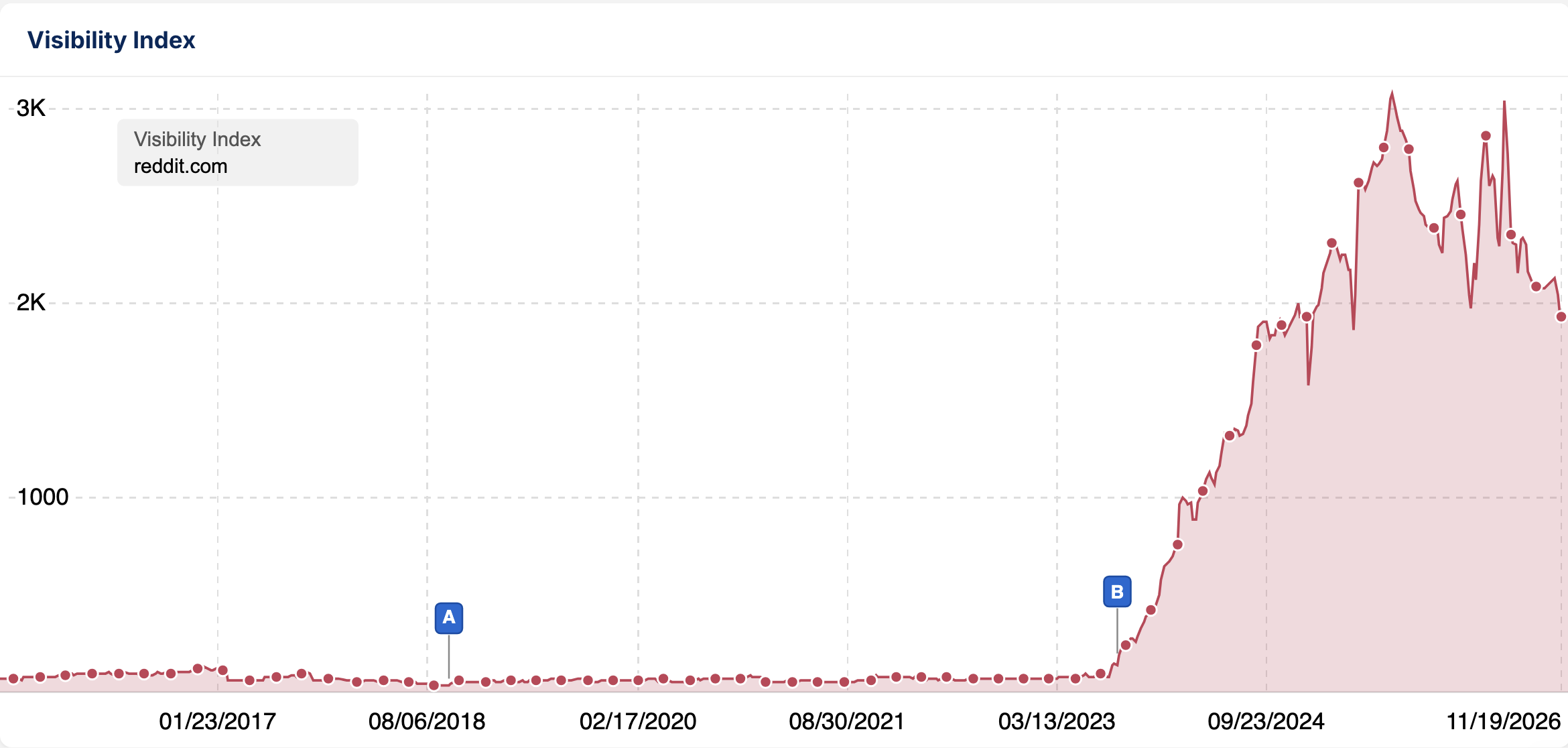
- 2023: Reddit takes over within the “Hidden Gems” period of Search. In Might 2023, Google mentioned it wished to floor extra “hidden gems,” like a discussion board remark or a publish on a small weblog. Later that 12 months, it confirmed the adjustments had been rolling out for months as a part of core rating, constructed to indicate extra firsthand data and private expertise from boards, social media, and blogs.
- By November 2023, I used to be posting on LinkedIn that Google appeared to be “manner overindexing on ‘genuine content material’ and ‘actual expertise’” in its search outcomes. Social media, UGC, and boards had been by far the largest successful class in my 2023 winners and losers evaluation, and my former intern Silvia Gituto’s deep dive on Reddit discovered it went from the 68th to the fifth most seen area in Google’s US search outcomes (per Sistrix) in a single 12 months. At one level, a five-year-old Reddit publish from a since-deleted account outranked the Mayo Clinic for “methods to potty practice a boy.” The period of actual experience-focused UGC had arrived.
- 2025 and 2026: a renewed give attention to particular person creators. In September 2025, Google redesigned Google Uncover so customers can observe particular person creators, then launched Search profiles: claimable, verified pages for creators that customers can observe instantly from Search.
- In October 2026, Damien Andell of 1492.imaginative and prescient flagged a Google job posting about turning Uncover right into a “proactive, hyper-personalized feed,” and famous that it explicitly requires protecting human voices and sources on the heart. His workforce has additionally documented Instagram and TikTok posts being examined in Uncover, alongside X and YouTube. With these adjustments, particular person creators get to play an even bigger half in Google’s model of a personalised social feed.
AI Search Cites The Locations The place Folks Share What They Know
Actual specialists and actual lived experiences seem to drive an enormous share of AI search citations, and you’ll see it wherein websites get cited most. YouTube and Reddit are constantly the 2 most cited web sites in Google’s AI Overviews, at 24.5% and 18.1% of citations among the many prime 50 cited domains in Ahrefs’ November 2026 evaluation.
Different research level to LinkedIn, too. In a Semrush examine of 325,000 prompts earlier this 12 months, LinkedIn was the second most cited area in ChatGPT Search, Google AI Mode, and Perplexity, and 59% of the LinkedIn content material cited in ChatGPT Search and AI Mode got here from particular person members slightly than firm pages.
This doesn’t shock me – I’ve seen my LinkedIn posts and Pulse articles present up in Google’s AI search outcomes instantly after publishing, like this check I did with a LinkedIn Pulse article about Google Uncover. It earned the highest rating in AI Overviews and an AI Mode quotation inside seven hours of publishing.
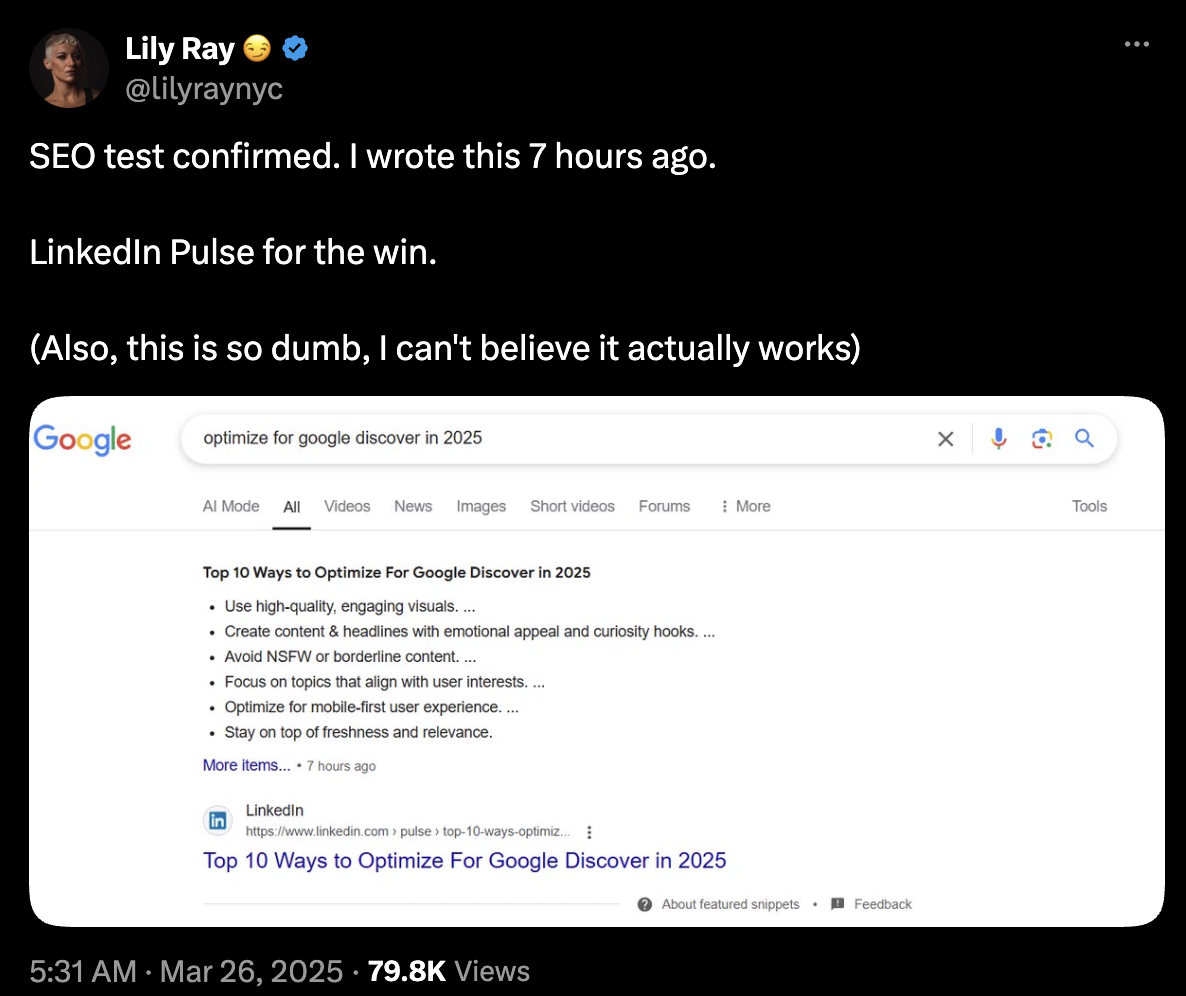
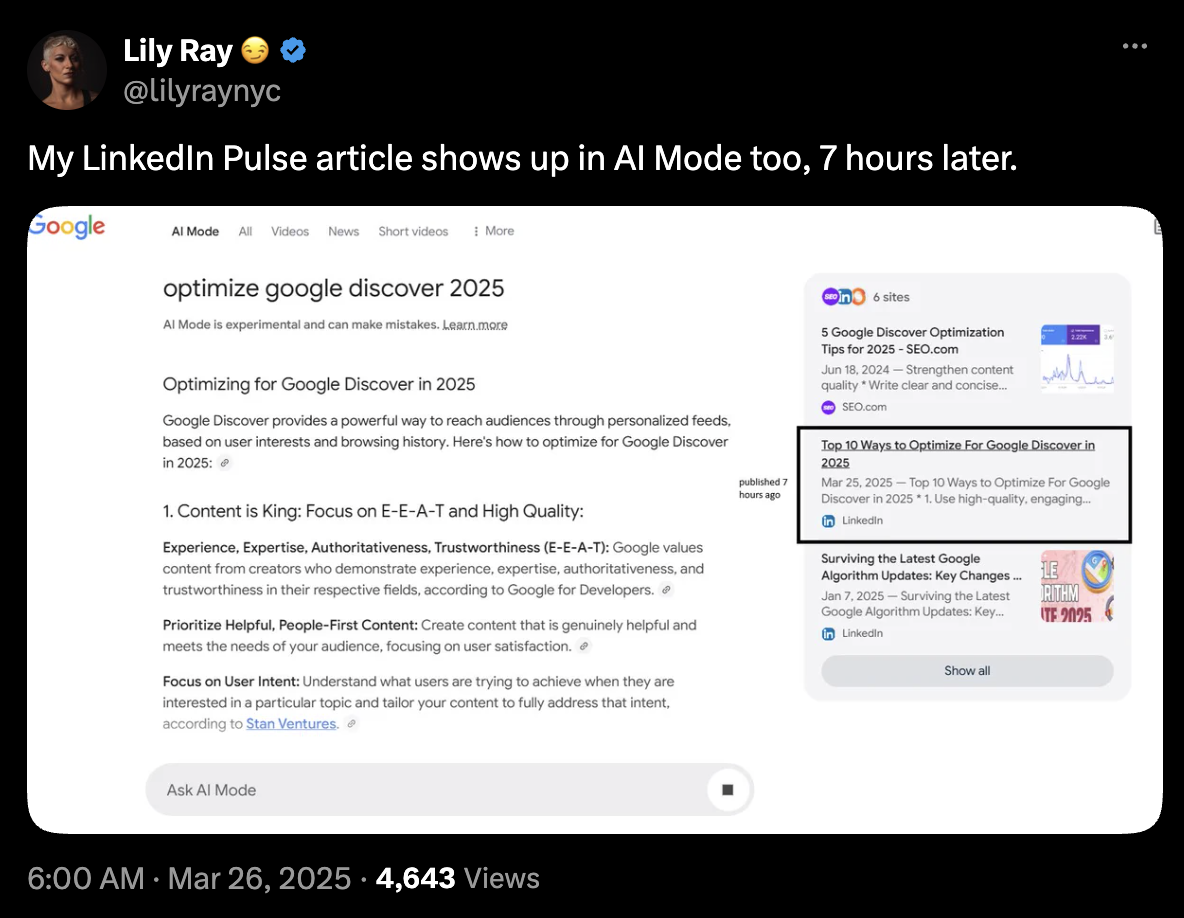
In different phrases, a whole lot of the data AI search methods draw on to construct responses comes from the locations the place actual people go to share what they really know, like a creator on YouTube strolling by how they fastened one thing or which product they like finest, a Reddit thread filled with firsthand expertise, or a practitioner’s considerate LinkedIn publish or Pulse article. Sadly, these similar platforms are additionally being flooded with AI slop, and it’s not a secret.
YouTube And Reddit Are Cracking Down On Inauthentic Content material
YouTube and Reddit have been pretty specific about what they need, and it additionally factors to genuine human experiences. In July 2025, YouTube renamed its “repetitious content material” monetization rule to “inauthentic content material,” masking AI-generated movies constructed from generic templates “with out including the creator’s authentic, genuine insights or perspective,” and CEO Neal Mohan’s 2026 letter referred to as out “AI slop” by title. Reddit CEO Steve Huffman wrote in February that “for those who can’t simply distinguish an actual particular person’s ideas or suggestions from a bot, that belief erodes,” and a month later Reddit began labeling automated accounts. On each platforms, essentially the most dependable path to visibility seems to be the one this complete publish is about: be an actual, identifiable particular person – sharing genuine and sincere experiences – whom different folks select to belief.
One Individual Can Change How A Firm Is Perceived
I’ve seen firsthand what sharing publicly can do for a enterprise. Once I joined Amsive, I had by no means given an search engine optimization speak on a stage or accomplished something public-facing within the trade. Since then, in nearly 9 years on the company’s search engine optimization workforce, I’ve revealed analysis on its weblog below my very own title, alongside podcast interviews, convention talks, webinars, and different advertising and marketing efforts on the company’s behalf. That work has introduced the company hyperlinks, visitors, and title recognition that continue to grow lengthy after every bit goes dwell. Once I not too long ago appeared on the company’s backlinks in Ahrefs, a couple of issues stood out:
- Interviews and collaborations I’ve accomplished with journalists have earned Amsive hyperlinks and model mentions on high-authority publications just like the New York Occasions, BBC, Washington Publish, CNET, and plenty of extra.
- 9 of the ten most-linked articles on amsive.com are authentic information research from the search engine optimization workforce, together with seven I wrote or contributed to.
- About 1 in 13 of the roughly 7,800 websites linking to amsive.com point out my title in or proper subsequent to the hyperlink, often as a quote from an article or interview.
- My writer web page on amsive.com is linked from 120 websites, greater than all however seven of the corporate’s articles.
I’m sharing this due to the place these hyperlinks level: each one in all them goes to the corporate. One particular person (or a workforce of individuals) sharing what they know below their very own names can develop an organization’s authority in a manner that model content material by itself hardly ever does. I’ve seen the identical sample at numerous different manufacturers that put trusted specialists on the entrance of their advertising and marketing, and I attempt to make use of this similar method in my consumer methods.
In fact, I’m not the one instance of this, and others within the trade are seeing success with the identical method. For years, Wix had what the Ahrefs weblog referred to as “a little bit of a foul status for search engine optimization.” Loads of SEOs would have steered purchasers away from it. Then Wix did one thing sensible: it employed revered SEOs like Crystal Carter and Mordy Oberstein to signify the model inside the search engine optimization neighborhood.
Crystal joined in 2022, and since then she has spoken at many main search and advertising and marketing conferences, co-hosted Wix’s SERP’s Up podcast, and revealed her personal analysis on the Wix website. At the moment, when search engine optimization publications write about whether or not Wix is sweet for search engine optimization, they usually level to her by title. That very same Ahrefs article credit her and Mordy with pushing for “extra search engine optimization options and higher communication.” About 1 in 20 websites linking to Wix’s search engine optimization Hub point out Crystal by title, the podcast reveals up in “finest search engine optimization podcasts” roundups from Backlinko and Ahrefs, and her skilled web page is the most-linked skilled profile on the hub.
For a extra well-known instance exterior our trade, have a look at journey skilled Rick Steves. He self-published his first journey information in 1980, and he has spent about 4 months a 12 months in Europe for many years, strolling the routes himself and updating his guidebooks yearly. That one particular person’s lived expertise grew into an organization with greater than 100 staff, a PBS sequence that has run since 2000, a thriving discussion board and on-line neighborhood, a public radio present, and a tour program that takes greater than 30,000 vacationers to Europe annually.
I wrote about his website on LinkedIn this summer time, calling it the final embodiment of E-E-A-T and the right instance of an expert-led advertising and marketing method. He tells you – from firsthand expertise – what’s overrated, overpriced, or skippable, and since he makes cash from books and excursions, his content material is free from affiliate affect. His honesty is the product. Google’s AI Overviews usually cite his web site, and his YouTube and TikTok pages too.
How To Construct A Human-First Technique With Model Evangelists
Manufacturers that may ought to begin by figuring out the actual specialists inside the corporate and investing in making them seen. In follow:
- Discover the boots on the bottom – the individuals who truly know issues. Your product lead, your head of assist, the engineer who solutions each arduous query in Slack, or the founder who nonetheless takes buyer calls.
- Construct up their presence in your website. Give attention to constructing sturdy About pages, writer and skilled pages, and some other alternative to showcase the actual folks and actual specialists on the firm. Use their writer profiles to spotlight the nice work they’ve accomplished, connect with their social properties, and deal with the web page as a private portfolio for the skilled. Give them a voice, and a manner of contributing to firm communications, whether or not it’s contributing to the weblog or constructing a platform on LinkedIn to assist their efforts on the firm.
- Encourage them to construct an skilled footprint exterior your website. Specialists can provide convention talks, do podcast interviews, or assist with posts on Reddit (and even assist handle the official branded subreddit), LinkedIn, or different on-line communities the place your consumers spend time. Assist them earn and declare their Data Panel and, after they qualify, their Search profile. Consider it as a manner for them to construct their private model, whereas concurrently rising visibility for the corporate.
- Maintain the pitch out of it. People observe people who find themselves genuinely helpful to them, and efficient advertising and marketing is more and more turning into genuine, not salesy. Share the info, the errors, the “I don’t know but,” and credit score different folks’s work generously.
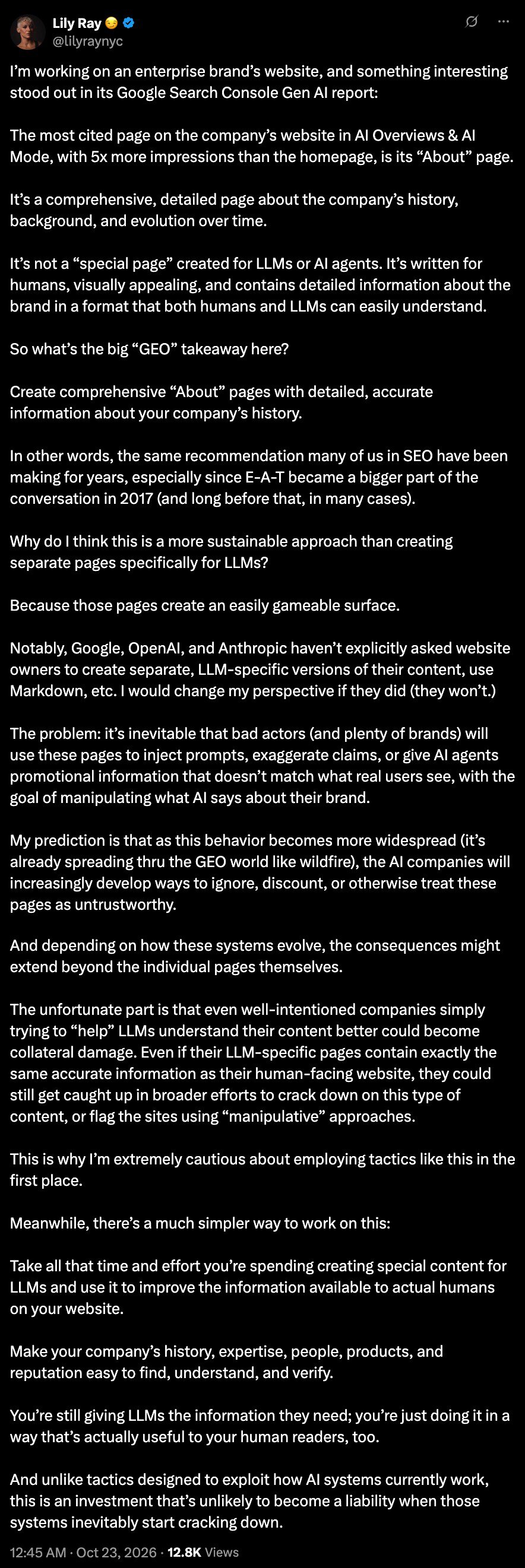
- Make your folks simple to confirm. In October, I shared that essentially the most cited web page on an enterprise consumer’s website in AI Overviews and AI Mode was its About web page: an in depth, human-readable historical past of the corporate. I nonetheless imagine About pages are usually underinvested in.
Two truthful counterpoints, since this method isn’t doable for each firm: Some industries have compliance groups that make private posting genuinely arduous. And other people might go away the corporate and take their private manufacturers with them. My reply is to attempt to construct a number of voices as a substitute of counting on one (my good friend and colleague Viola Eva not too long ago wrote about how they do precisely this at her firm, Circulation Company). Moreover, keep in mind that any hyperlinks, mentions, and protection earned whereas somebody represented the corporate can stay as priceless property for the corporate, even after they transfer on.
Why This Stands The Check Of Time
In July 2023, I posted on LinkedIn that even when Google couldn’t inform AI content material from human content material, another person might: “guess who else doesn’t like studying AI content material? USERS.” The patron analysis has since caught up. A Gartner survey this summer time discovered {that a} majority of U.S. customers say AI content material has made them much less trusting of name messaging, and Emplifi’s 2026 analysis discovered that solely 35% of Individuals belief AI-generated content material in any respect (not that everybody can essentially inform the distinction). I’d name it slop fatigue, and I feel the platforms are lastly responding to it (or a minimum of making an attempt to).
Each tactic that has blown up on this trade, from the hyperlinks I purchased in 2011 to the listicles and paid mentions everywhere in the web in 2026, was scaled for the only goal of driving visibility in search. That’s additionally, nearly precisely, the record of issues customers say they dislike most about search engine optimization. Actual specialists and skilled contributors have the alternative impact: they contribute the issues that make the web human, and the preferred, extensively cited platforms are working arduous to protect their humanness in an web flooded with AI slop.
There’s one more reason this holds up: your status is finally determined by what different folks say about you, not by what you say about your self. One of many rater guideline passages I placed on a slide again in 2019 reads: “When there may be disagreement between what the web site says about itself and what respected impartial sources say concerning the web site, we’ll belief the impartial sources.”
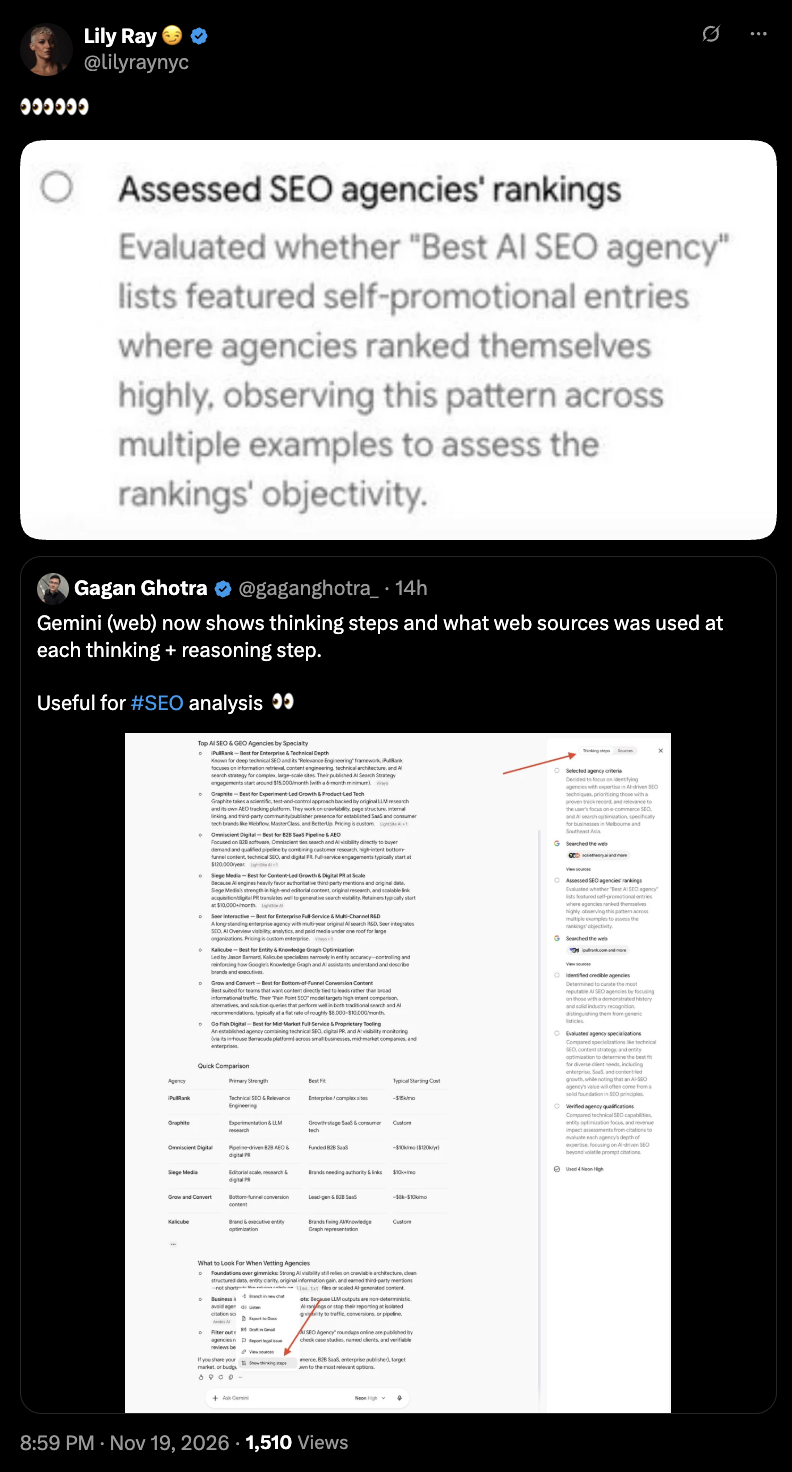
AI search is carrying that torch ahead, as LLMs are getting higher and higher at figuring out somebody’s status based mostly on what others say concerning the model or the particular person. That seems to more and more embody recognizing self-promotion. Gemini now reveals its reasoning steps, and on this instance (h/t Gagan Ghotra), it instantly evaluated whether or not “Greatest AI search engine optimization company” lists had been self-promotional, with businesses rating themselves extremely, to evaluate how goal these rankings had been. Being genuinely really useful by different folks is essentially the most sustainable manner ahead.
Folks like following folks. That was true earlier than Google, and it’ll nonetheless be true after no matter comes subsequent. The manufacturers that determine that out gained’t want the following loophole.
Extra Sources:
This publish was initially revealed on Lily Ray NYC Substack.
Featured Picture: Spiximcreation/Shutterstock

