

Meta has revealed its Q3 earnings report, which reveals that the corporate’s advert enterprise stays robust, whereas its AI expenditure continues to rise.
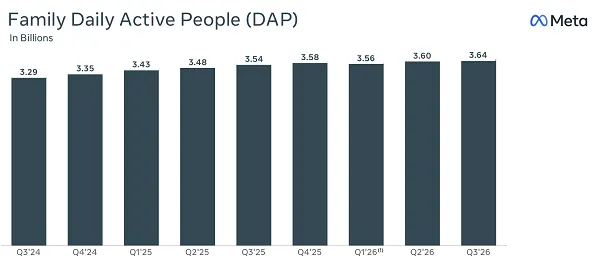
First, on utilization. Meta reported that its household every day lively individuals depend, which is the cumulative variety of lively customers throughout Fb, Instagram, Messenger, WhatsApp and Threads, rose by 40 million to three.64 billion general within the third quarter.
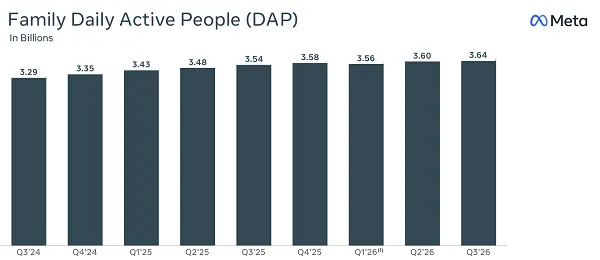
The truth that Meta’s apps are nonetheless drawing in customers is a testomony to its development technique, with the corporate stuill rising its viewers in a number of key markets.
India is now Meta’s greatest single consumer market, with advancing connectivity within the area offering new alternatives. In the meantime, Meta continued to construct its presence within the Asia Pacific, the place its advert impressions have grown by 24% this yr, in keeping with Merca 2.0.
Total advert impressions throughout Meta’s apps rose by 10% in Q3, per Meta, although that is a slight decline on its newer quarterly efficiency.
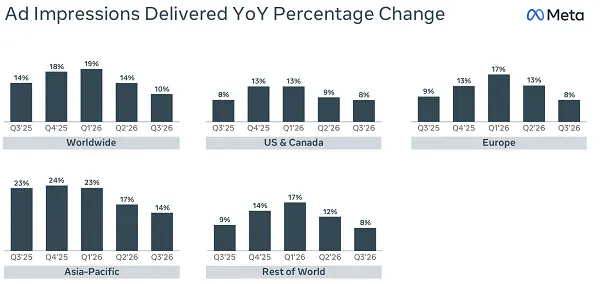
Which is a bit of unusual, provided that Meta has added extra advert placements, with Threads gaining extra traction
Meta additionally reported that Threads has now overtaken X by way of general month-to-month lively customers, which Meta CEO Mark Zuckerberg claimed in an interview final month. That ought to present extra advert alternatives, however perhaps Threads adverts have already reached saturation level, which is why these figures are normalizing.
Regardless, Meta has been capable of offset no less than a few of the slowdown in advert impressions by rising advert costs, which had been up 14%.
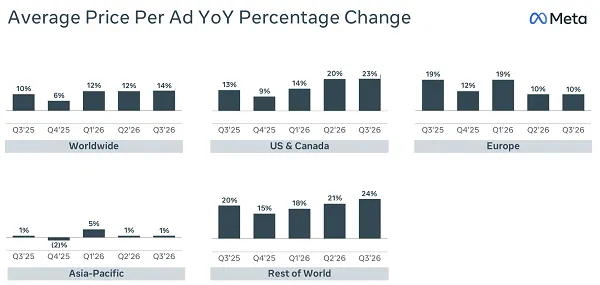
Which might be not the best information for entrepreneurs, however Meta’s counter could be that its adverts have gotten extra precious via its enhanced advert focusing on, powered by its evolving AI fashions.
The top consequence right here noticed the corporate’s third quarter income rise 26% yr over yr to $64.6 billion.
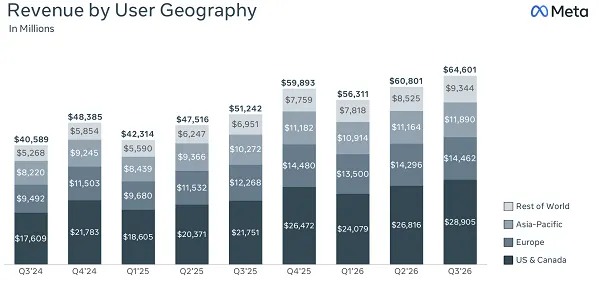
So Meta’s advert enterprise remains to be comfortably propping up outcomes, even with its huge enhance in bills associated to its evolving AI push.
Certainly, Meta reported a 68% enhance in year-over-year bills in Q3, pushed primarily by capital expenditures.
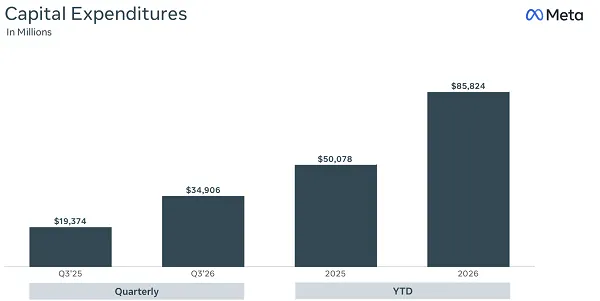
Whereas this chart can also be beginning to look regarding:
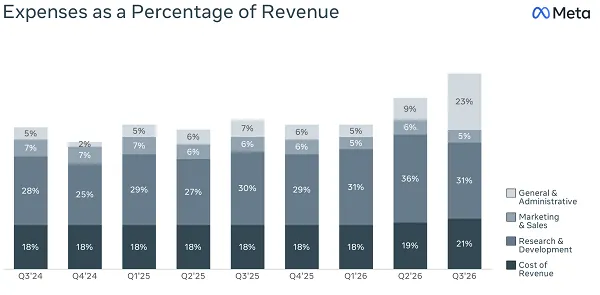
Meta beforehand knowledgeable the market that its bills would proceed to rise consistent with its AI funding, with the corporate pledging greater than $600 million to AI infrastructure initiatives.
The above graphs displays this, displaying the large price of enhance in Meta’s AI spend, and additional underlining why the corporate wants to make more cash from its AI instruments.
As a result of proper now, it’s not making lots from these next-level bets.
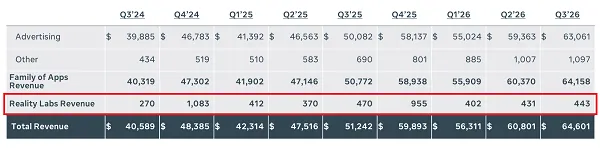
This itemizing reveals that Meta’s Actuality Labs division, which covers its AI glasses and VR headsets, introduced in solely barely extra income in Q3 versus the earlier quarter,
It’s not possible to match that towards prices, as a result of Meta’s AI glasses are tied to its broader AI spending. Nevertheless it’s secure to say that the backlash towards the misuse of those glasses has brought on a slowdown in gross sales and impacted one other avenue for AI monetization.
Which implies that Meta will likely be more and more reliant on its Muse brokers to drive client AI adoption. The corporate is hoping that take-up of Muse will ultimately allow it to realize extra income by taking a proportion of gross sales exercise performed via the app.
Nonetheless, Muse can also be dealing with its personal challenges, with numerous experiences of information exposures and unintended utilization missteps.
Final month, a Muse consumer mentioned that the AI bot gave out his residence tackle with out him understanding, with the intention to set up a Fb Market pick-up. Then this week, Ars Technica reported that safety agency Claroc was capable of receive reams of data on Muse consumer queries via easy exploration strategies.
Meta is working to reassure customers that Muse is secure, and has been constructed with information safety in thoughts. However extra circumstances like it will proceed to harm Meta’s fame, and will make individuals much less prone to undertake its Muse chatbot or use it to its full extent.
Certainly, Morgan Stanley lately reported that Muse use retention declines considerably two weeks after preliminary obtain, as per this chart posted by @IntelFabs on X.
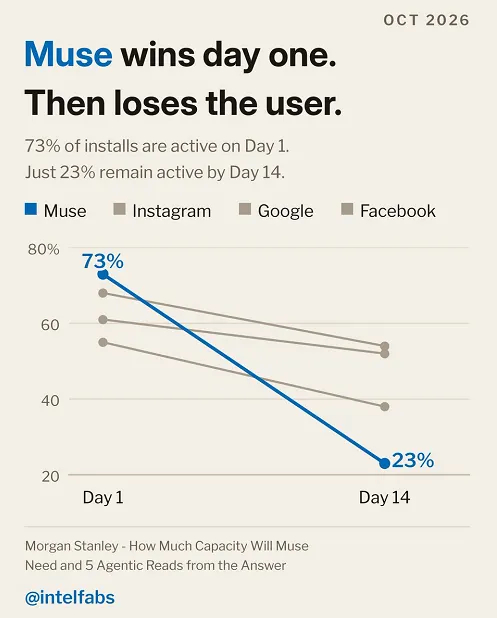
That retention price, nonetheless, is barely higher than what different AI chatbots have seen, with ChatGPT, Claude and Grok all experiencing related utilization drop-offs after obtain.
As such, it’s tough to say how important that is by way of Muse utilization tendencies, and it’s tough to foretell the potential for the chatbot to drive income for Meta in future.
However based mostly on its present spending, Meta’s all-in wager on AI remains to be not near producing any important income alternatives, and it will really want Muse to be successful if it needs to show that round any time quickly.
However then once more, if its advert income continues to climb, Meta can preserve no less than some buffer towards these losses. That’s, till all of its AI spending comes due, and its traders get more and more fearful in regards to the angles of those charts.
One closing attention-grabbing level from Meta’s Q3 report: “Headcount was 66,775 as of September 30, 2026, a lower of 15% year-over-year.”
Meta has continued to change human employees with AI instruments, and this determine seemingly displays that shift.

