

In February, Bing launched the general public preview of its AI Efficiency Reporting perform inside Webmaster Instruments. Since then, now we have been utilizing it to gauge a bit extra perception into what Bing is citing and what could be impacting these outcomes. Monitoring totally different websites since then, we got down to analyze greater than 883,000 AI citations throughout 26 manufacturers, which surfaced a couple of issues that will shock you.
Weblog posts, product pages, and homepages account for lower than half of the citations in our pattern, 42% mixed. The opposite 58% is a mixture of app pages, sights lists, instruction manuals, course catalogs, key personnel administrators, and PDFs that no one on a content material group was doubtless serious about.
The one most cited URL in our information set was an app web page for a shopper product with an built-in cellular app element. The second was an sights listing for a tourism vacation spot group.
There actually are different instruments on the market on the disposal of SEOs that assist us perceive what AI citations would possibly appear like, however on the time, this information was reported out of the one first-party device within a search engine to take action. As quickly as entry was offered in February, we pulled AI stories for 15 totally different manufacturers and printed our findings. Since then, Microsoft has added query-to-page mapping, intent and subject labels, Quotation Share, and a Matters Portfolio beta. They’ve additionally backfilled a lot of the underlying information from earlier months’ releases, permitting us to drag information for a similar 15 manufacturers, plus an extra batch to identify any gaps or traits.
Working With Bing’s AI Efficiency Knowledge
Understanding semantic variations between searchers and the truth that the entire information contained in the AI Reporting is sampled to some extent, we began with the page-level reporting as a substitute of queries. Throughout most websites, the pages export will give you a broader information set to work from, additionally shifting you previous the frequent practitioner query, which is “what are folks prompting,” once we got down to attempt to higher perceive “what on my website does the machine really use?”
We explored the AI stories from 26 totally different manufacturers throughout 9 verticals. Included have been vacation spot advertising organizations, resorts and hoteliers, ecommerce manufacturers, B2B producers, schools and universities, an EdTech platform, regional healthcare suppliers, government-adjacent enterprise providers, and a monetary establishment.
Contained in the AI Reporting portion, we exported the three report views for every model: Grounding Queries, Cited Pages, and the Every day Overview. By the numbers, our overview totals delivered over 1.1 million citations throughout the manufacturers, with over 883,000 on 10,861 URLs and a grounding question export of practically 300,000 citations throughout 2,797 queries.
Grounding queries are the search phrases Microsoft’s AI generates to retrieve content material, not the phrases customers sort, and Microsoft states grounding question information “represents a pattern of total quotation exercise.” Pulling information from the autumn reveals us how a lot of a pattern. That means that for each model we reviewed, the question export sums to between 5% and 39% of the overview whole, and the web page export is between 63% and 100%. That’s the reason we used web page counts relatively than queries for sample recognizing.
Two extra guidelines have been held in the midst of our evaluation. First, no raw-count comparisons have been used throughout the intervals. Realizing Microsoft backfilled AI Efficiency information from June 1, 2026, Krishna Madhavan described the ensuing jumps as “simply common information backfilling” on X. Second, the 2 information pulls cowl totally different seasons, and we solely carried ahead the findings that held up throughout each, spring and fall, and put aside those that seasonality may clarify.
See additionally: Microsoft Readability Now Reveals Grounding Queries Behind AI Citations
What Bought Cited
Throughout all 883,313 web page citations, grouped by what the web page is for:
| Web page Kind | Share of Citations |
|---|---|
| Editorial articles and guides | 18.3% |
| Product and repair pages | 16.7% |
| Tutorial program and admissions pages | 12.8% |
| Assist, how-to, and documentation | 11.2% |
| Occasions and things-to-do pages | 11.2% |
| Homepages | 6.8% |
| Login, portal, and app pages | 6.0% |
| About, folks, and careers pages | 6.0% |
| Reference materials, archives, and course handouts | 4.5% |
| Listings and directories | 3.2% |
| Different | 3.1% |
| Lodging and rooms | 0.2% |
As one would possibly anticipate, pooled numbers are leaning towards massive websites, and the median model throughout the information seems fairly totally different. Product and repair pages accounted for 32%, whereas editorial content material was 15%, homepage 8%, and every little thing else thereafter was a lot smaller.
Citations look like pretty concentrated. Throughout the entire set, simply over 2% of the URLs carry half of all citations. Breaking this down much more, we famous that it takes 1,441 URLs in our information to succeed in 80%. For a typical model, the highest web page alone accounts for 12.7% of its citations and takes about 40 pages to succeed in 80% quotation quantity. As conversational search continues to develop, SEOs perceive that the long-tail queries are increasing, however most of what Bing’s AI pulls from is a handful of pages.
Sample Recognizing By Trade Vertical
Tourism Boards Get Cited For Issues To Do, Not Locations To Keep
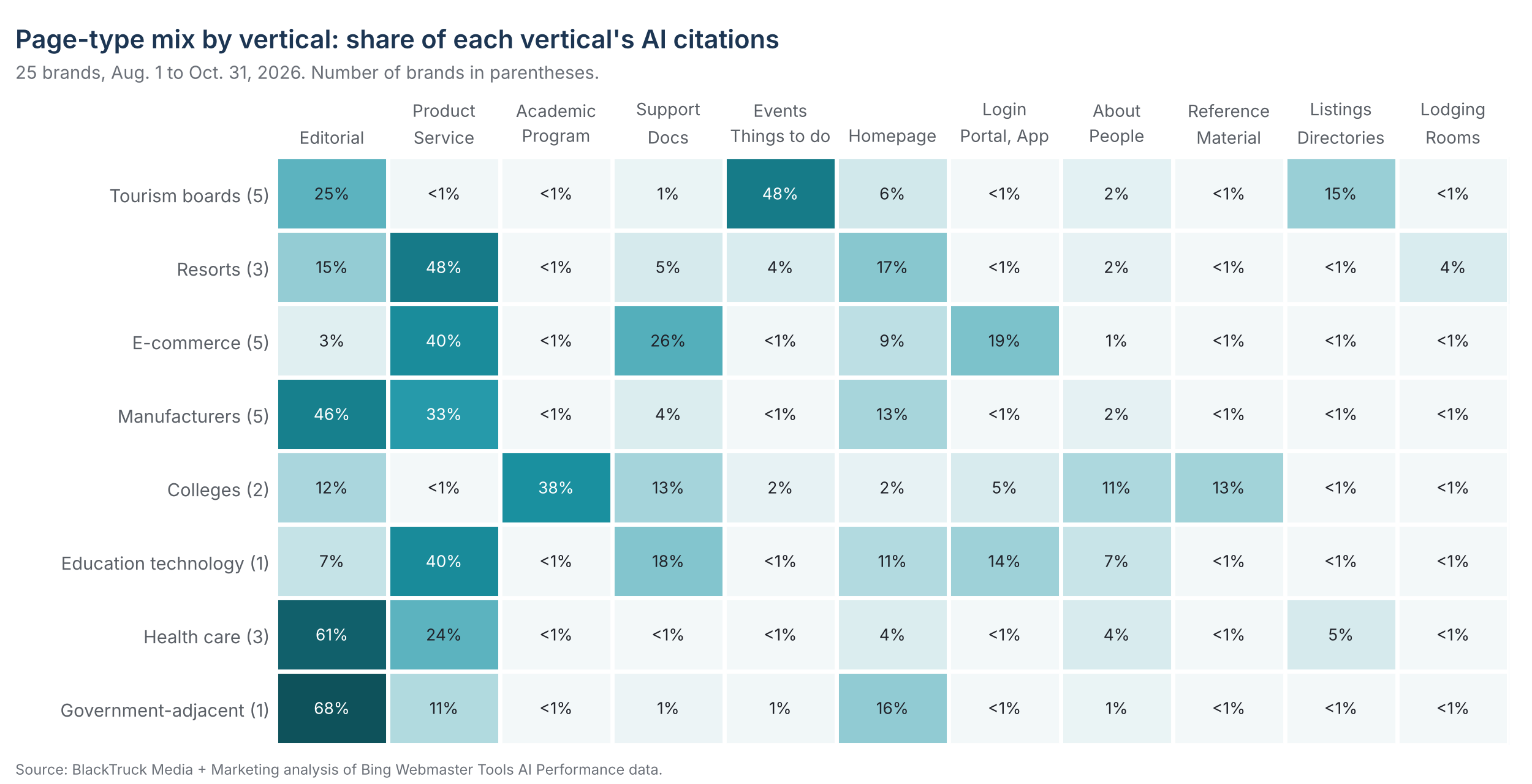
Throughout vacation spot advertising group web sites, occasions and things-to-do pages stay practically 50% of the citations, and itemizing directories make up one other 15%, with lodging-related pages falling in at below 1%. The one greatest anomaly that stood out was a tourism attraction listing with practically 17,000 citations. Grounding queries are extremely seasonal, with main occasions and festivals delivering a big share of the citations. What does this imply for vacation spot entrepreneurs? The websites are extremely wanted and relied upon for issues to do, see, and expertise, although much less doubtless for the precise locations to remain.
Resorts Get Cited For The Exercise, Not The Room
Desirous to discover extra lodging-oriented searches, we added in extra resort and hotelier properties the place heads in beds is a main perform of their enterprise. Lodging and reservations pages account for 4.3% of citations throughout resorts, whereby activities-related content material corresponding to golf, ski, eating, and packages pages account for practically 50% of the citations. Whereas one resort was cited for tutorial content material round golf methods, regional golf journeys have been extra more likely to garner the outcomes that generate optimistic conversations within the boardroom. What does this imply for resorts and hoteliers? Monitoring these traits over the course of a season, be it summer time or winter, permits a resort to see the exercise combine that rotates with the calendar. It’s price noting {that a} resort (not a lodge) is cited as a spot that does one thing, and virtually by no means as only a place to sleep.
Ecommerce Will get Cited For Assist As A lot As Merchandise
No shock to anybody growing search engine optimisation methods for ecommerce manufacturers, product and class pages account for 40% of the citations, with help and documentation-related pages residing at 26%, and particular app/login pages making up practically 20% of the citations. Stripping out the one model whose app web page is essentially the most cited URL in our research, the product pages rise to 64% of the citations. A second model that pairs a bodily product with an app and a service plan reveals the identical form. Its service plan and product help pages are two of its prime three cited URLs, and PDF instruction manuals sit in its prime 10. For manufacturers which are centered on the expansion of their app-enabled merchandise, this implies reviewing how you might be positioned to personal the help dialog. Much like conventional search, AI fashions look like simply positive citing your PDF paperwork, which ends up in a poor buyer expertise and places you down a path of hard-to-update legacy content material.
Producers Get Cited For What They Clarify
The nearer a B2B model is to the answer being delivered, the higher. Throughout the manufacturers reviewed, editorial content material accounted for 46% of the citations. At one manufacturing providers model with a world presence, over 70% of the citations have been URLs from technical how-to articles. The identical may be mentioned for coaching and tutorial-based content material, particularly video libraries, which accounted for 73% of citations. The exception to that could be a product producer whose catalog pages account for over 70% of the citations and one other 10% for product literature PDFs. That means, if you’re within the enterprise of constructing extremely specialised and technical merchandise, the machine is simply as completely satisfied sourcing its solutions from a PDF, although once more it causes extra friction on the aspect of the client and content material groups who must handle legacy updates over time.
Greater Ed Will get Cited For Applications And The Relaxation Of The Campus
Tutorial applications, admissions-related pages, and monetary support make up practically 40% of the citations for the upper ed vertical. From there, it filters out into reference materials and course handouts at 13%; help and IT-related pages additionally at 13%; editorial articles are available in at 12%, with school and about pages at 11%. For schools and universities, the majority of the pages being cited fall into extra of an information-gathering class round what programs are provided, when, and the monetary implications. For these working in academia, particularly greater ed, reviewing which of your pages are being referenced essentially the most ought to begin to give you insights on what your viewers is looking for. When you’re a college that’s constructed on analysis and research, there are clear alerts that optimizing who your persons are is a important step that’s doubtlessly ignored.
The Pages No person Is Anticipating To See
Throughout the verticals reviewed, three classes surfaced that no content material calendar is presently accounting for, and why wouldn’t it? Noting PDF paperwork account for over 6% of all citations in whole. Throughout the EdTech platform we reviewed, they account for practically 17% of citations, with course catalogs additionally following the same pattern. Inside one college, PDFs have been 11% of their citations, surfacing parts from not simply the course catalog but additionally core necessities that college students want by program. Definitely, should you’re seeking to personal extra of the dialog round your applications and what college students can anticipate vs. letting the AI base it off of outdated PDFs, it is a prime alternative to take motion.
At one ecommerce model, PDFs have been 10.4% of all citations, all of them instruction manuals. This serves as a reminder that if a PDF is one of the best doc you could have on a topic, it may very properly be cited as one of the best doc you could have on the matter itself. For manufacturers with merchandise that require technical help, whereas revising a single PDF would possibly appear to be the method to take, think about what number of PDF paperwork are residing in your CMS which are outdated vs. putting the precise useful data in an HTML format in your website.
The homepages of many web sites don’t go unnoticed in our evaluate. Homepages are 6.8% of all citations pooled, and the homepage is the only most cited web page for 9 of the 26 manufacturers reviewed. When nothing else on a website carries deeper insights concerning the model, its providers or merchandise, the homepage is carrying a a lot greater share of the citations. It doesn’t matter the scale of the model both; that’s a sign that’s price reviewing that can assist you decide what the AI is considering your model.
Throughout healthcare, schooling, and EdTech, folks and about pages carry between 4% and 11% of citations by vertical, and 18% at one college. When the AI reply is said to who you might be as a model or a person, the place you might be situated, and the important thing people who work there, these pages grow to be important parts when directing the LLMs. What number of of those web page sorts get printed as soon as, solely to by no means be revisited and stored updated?
What Modified Since February
Wanting again to an early research we did on the insights on what Bing’s Webmaster Instruments was telling us about AI Citations, we revisited 15 of the unique manufacturers to find out what shifted over the course of time. Most of what moved was seasonal, and primarily based on that, we determined to depart these parts out. Nonetheless, we did discover three areas price investigating additional.
Login Lookups Left The Grounding Knowledge
In our authentic evaluate in February, login, portal, and sign-in queries accounted for roughly 18% of all citations throughout the manufacturers. Within the fall window, that shrunk to only above 1%.
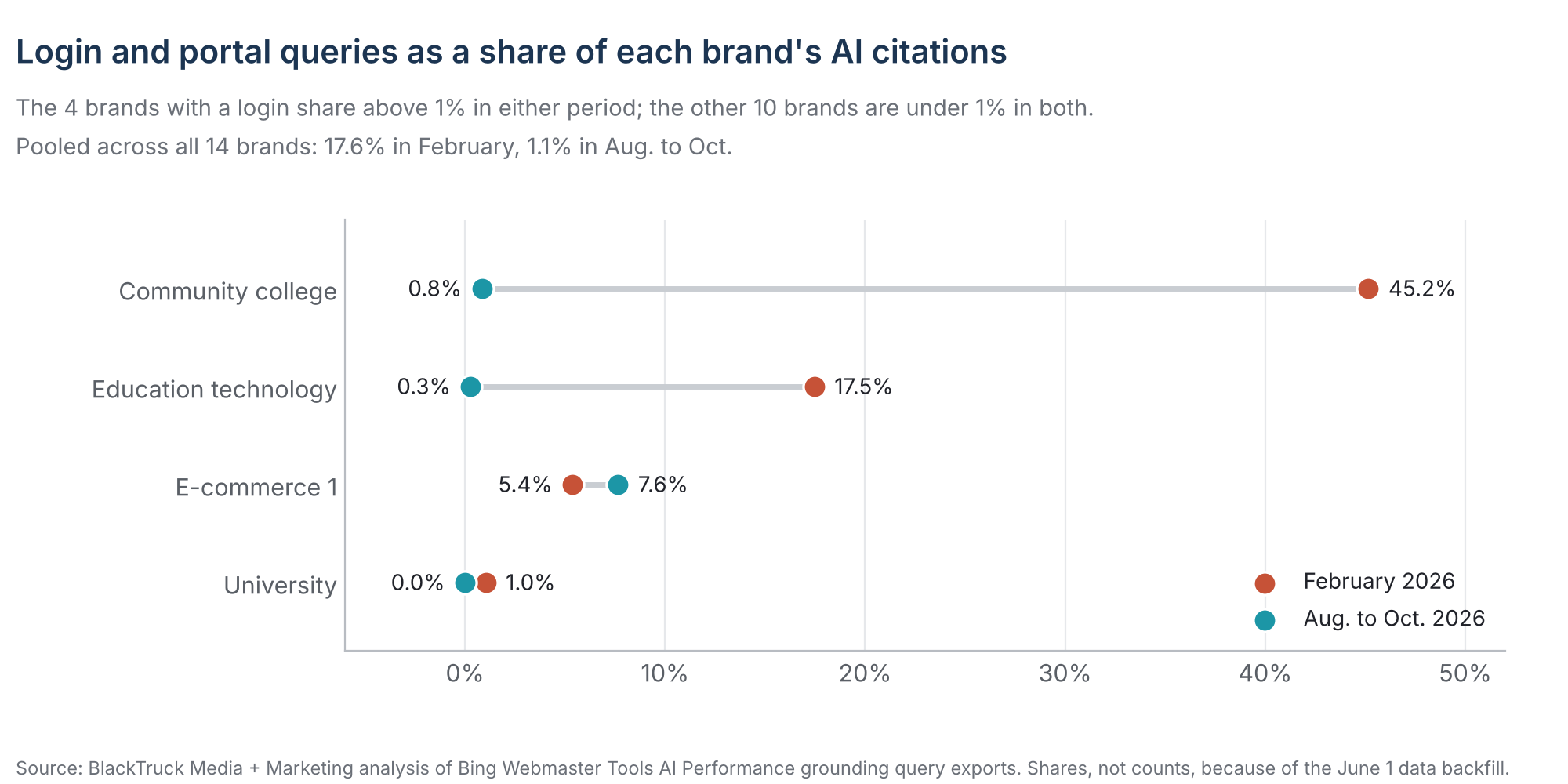
Throughout the greater schooling sector, 45% of the citations initially got here from login and portal queries. As we noticed this shift into the autumn, the identical variety of grounding queries had dropped to only shy of 1%. Login queries for the EdTech model additionally dropped from 17% to lower than 1%. And whereas there actually is the seasonal argument to be made, we are able to take a look at August via October as being key occasions at most universities and schools as the beginning of a semester. We anticipate institutional login lookups to extend round that point, and actually, they didn’t.
Product help for the ecommerce manufacturers went the opposite route, with one model’s help and access-related content material rising from 17% to 42% of its citations. Noting that fall is the height season for the model and that demand is trending precisely the place you would possibly anticipate it to be.
Bing’s June replace added intent labels to the reporting, with Navigational amongst them. The February login queries are precisely what that label would catch. It additionally would seem that Microsoft has not mentioned it suppresses AI solutions in another way throughout intent sorts, and what we’re describing is extra of a sample to identify and never a mechanism inside the report.
Grounding Queries Flip Over Quick
For the median model, solely 37% of the citations present in our February evaluate got here from question strings that also seem within the fall export, and that’s earlier than accounting for any seasonal shifts. Throughout every of the model’s prime ten queries this spring, we word that roughly 56% are utterly absent from the autumn information pull. In case your model operates round any cyclicality the place it’s impacted by main occasions, holidays, and even seasonal actions, that explains among the distinction however not all.
Location-Solely Queries Vanished
Throughout the unique information pull in February, we discovered a handful of location-only queries. People who included [events near me], [concerts near me], and [holiday events near me], with out a vacation spot even within the question string, have been current. Revisiting the identical manufacturers this fall, we see that the close to me question left the information. Noting most of the AI-generated search outcomes are favoring websites corresponding to Eventbrite, Ticketmaster, and related aggregator websites. The extra native and regional centered your model is, corresponding to a multi-location storefront, the location-based information goes to be stronger and certain consistent with what you expertise in conventional search.
Model Vs. Non-Branded Queries
We proceed to see branded searches unfold into the AI Overviews in Google, but the information popping out of Google remains to be not as detailed as we want. Inside Bing, we do get a view into Quotation Shares, which was added in June. This stories on the share of citations your website receives out of all citations proven for a grounding question, which ought to enable you to decide how a lot of the reply your model really holds.
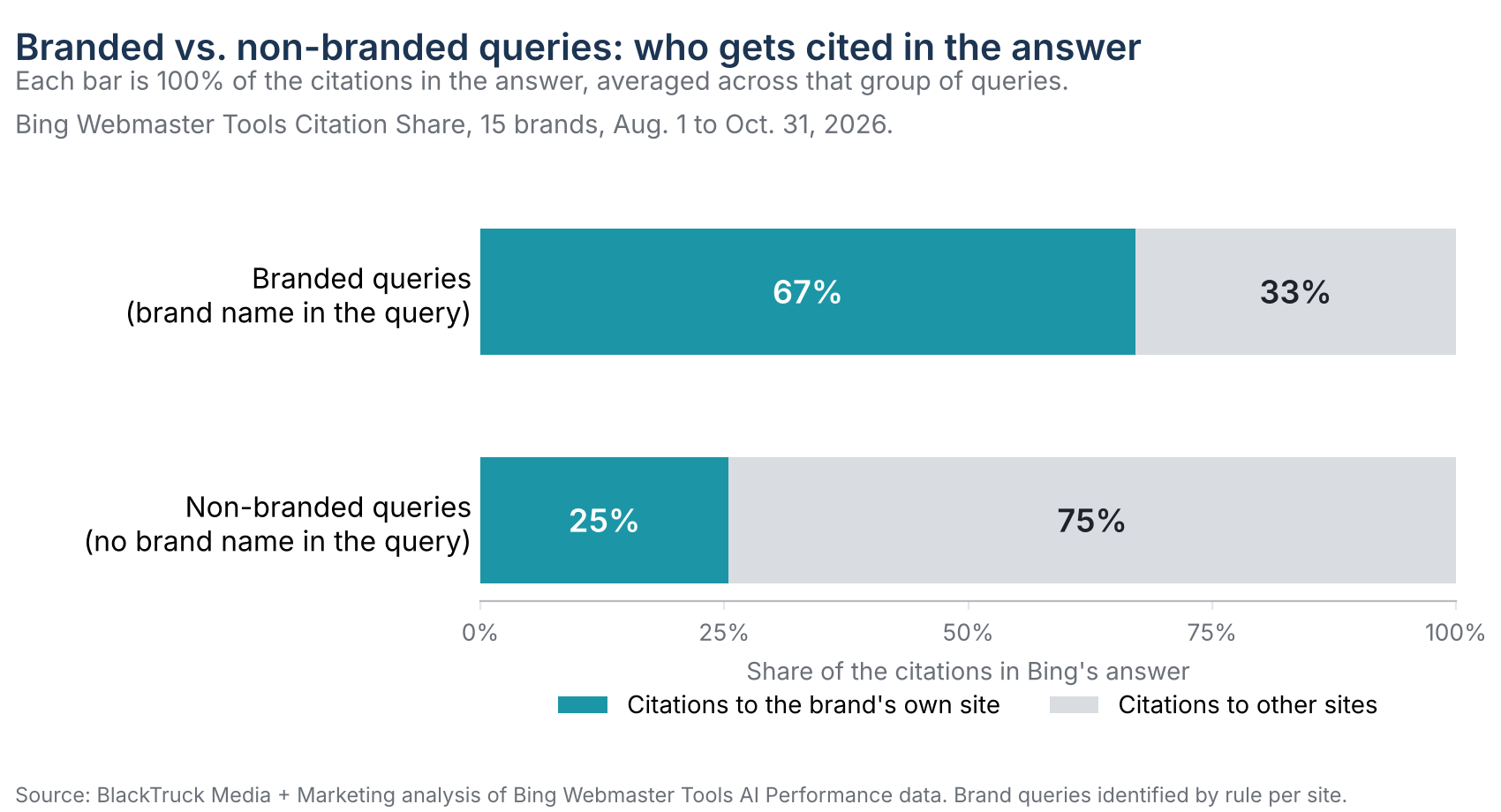
Quotation Share is Bing’s measure of how a lot of a solution your website has provided. For every grounding question, it stories what proportion of all citations proven for that question pointed to your pages. On branded queries, the websites in our evaluation provided 67% of the citations, and different websites provided 33%. On non-branded queries, the websites provided 25% and different websites provided 75%. Examine this to your conventional search outcomes and decide how a lot your branded searches are triggering AI-generated outcomes.
Non-branded searches are likely to at all times be the chance in conventional search, and AI-generated outcomes are actually no totally different. The information in our most up-to-date sequence of exports confirms this. On a non-branded question, three of each 4 citations are going to another person.
What The AI Efficiency Dashboard Will Not Inform You
Up entrance, know that the information is all sampled, however doubtless one of the best now we have to work with in the mean time. The pipeline is continually backfilling, so a rise throughout a three-month time interval may point out extra utilization, extra backfill on latest dates, or each. Proper now, the advice is to make use of the information as a information and report on what the dashboard reveals relatively than calling it development.
Total, Bing’s intent labels maintain up properly, although it might be argued that their subject labels don’t but. Our evaluate confirmed one shopper product model filed below “Dwelling Safety Programs” for 57% of its citations. Microsoft’s June put up permits that labels “could also be broad” for area of interest domains, so plan on re-sorting them your self. It’s additionally price noting that not each grounding question traces again to an individual. Queries of seven or extra phrases grew from 1% of citations in February to three% this fall, and a few of them are plainly monitoring instruments working on a schedule. Quotation counts in any device will embrace machine-initiated queries, and no report separates these out presently.
Steps To Evaluate Bing’s AI Reporting
- Pull the pages export, not the queries. Relying in your model, it gives an even bigger image relatively than simply question information. Rank your cited URLs, draw a line at 80% of citations, and that’s your AI content material stock as a baseline.
- Audit the pages you by no means deliberate. PDFs, workers bios, the areas web page, the app obtain web page, the FAQ. These are all being cited now, however are they present and structured to say what you need them to?
- Cease treating login and portal citations as visibility. They have been 1 / 4 of some manufacturers’ February numbers, and they’re gone. In case your baseline leaned on them with none context, you’re going to have some explaining to do.
- Construct the web page that solutions the category of query, not the string. About two-thirds of February’s citations got here from queries that not seem, but the pages that answered them are nonetheless being cited. Does chasing the precise question string get you long-term outcomes?
- Measure non-brand quotation share and deal with it because the quantity. Model queries must be yours by default. Evaluate the Quotation Share column to gauge insights on the non-branded work to be carried out.
Whereas Google stays the highest with regard to go looking quantity, the information popping out of their AI insights reporting is lackluster. Bing stays one of many higher sources for a website proprietor to gauge first-party insights on what will get cited. Simply be certain you learn it for what it’s: a sampling of your model’s information. Have you ever discovered Bing’s AI Efficiency Report back to be useful?
Extra Assets:
Featured Picture: Tetiana Yurchenko/Shutterstock

