

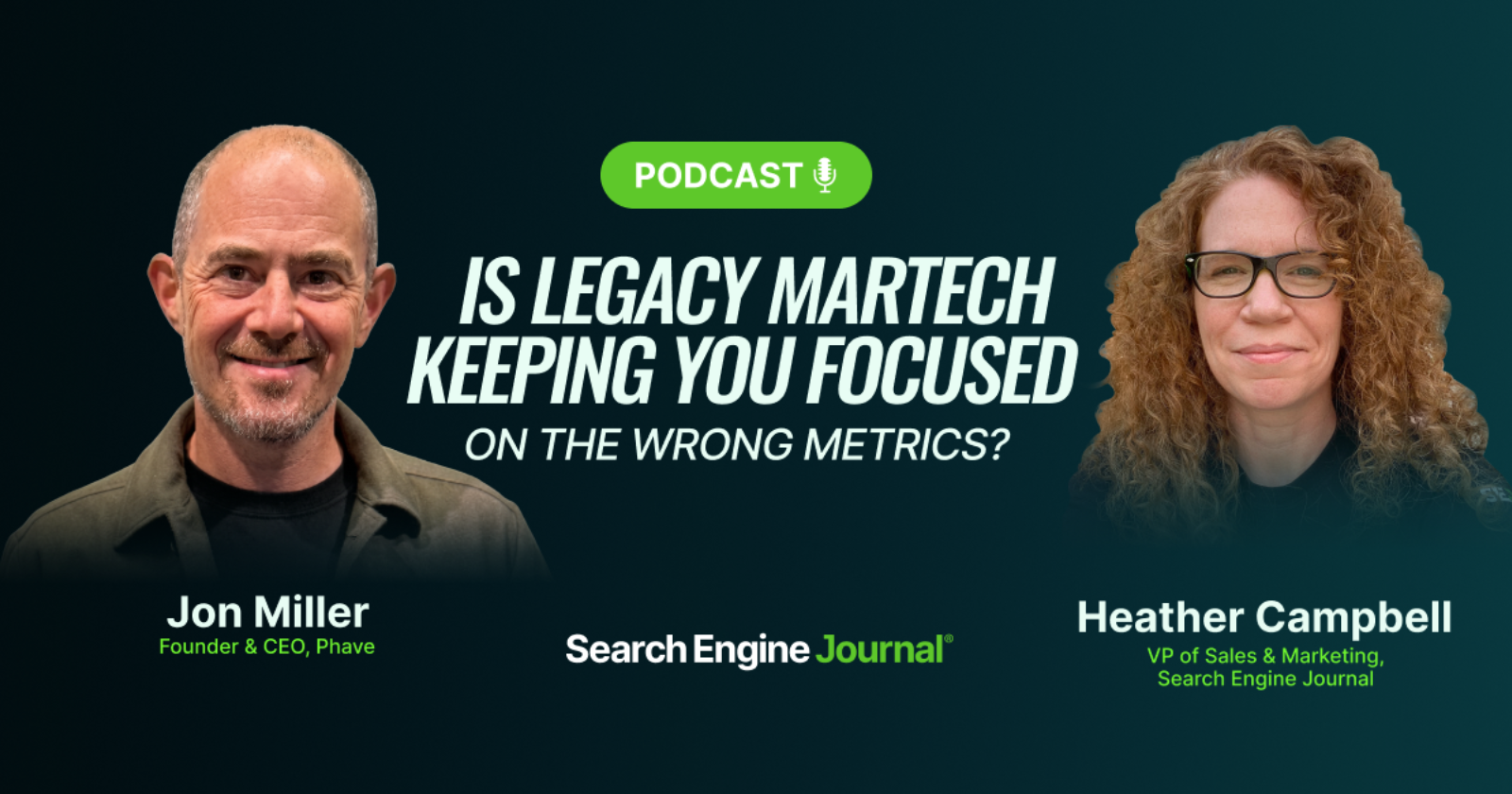
Is your advertising and marketing automation platform serving to you develop, or making it tougher to adapt? Jon Miller, co-founder of Marketo, Engagio, and Phave, joined me on the SEJ Podcast to debate the place he believes legacy advertising and marketing programs fall brief and the way AI may change the best way B2B groups work.
In our dialog, Miller defined why particular person leads and firm accounts can miss the complexity of shopping for teams, how marketing campaign queues and additional instruments can sign gaps in your platform, and the distinction between AI that builds rules-based workflows and AI that makes selections. He additionally shares why entrepreneurs ought to assessment renewal dates early and consider carefully earlier than committing to a multi-year contract.
Watch the podcast:
[00:40] Meet Jon Miller
[01:26] Why Miller Constructed Phave
[04:25] Rethinking The B2B Advertising Playbook
[06:11] Shifting From Guidelines To AI Reasoning
[07:58] Why Shopping for Teams Matter
[09:40] Indicators Your Advertising Stack Is Holding You Again
[12:47] AI That Builds Automation Versus AI That Is The Automation
[15:20] Reviewing Your Platform Earlier than Renewal
[17:09] The place To Discover Jon Miller
Editor’s Be aware: This transcript has been edited for readability and readability.
Meet Jon Miller
Heather Campbell: Thanks a lot for becoming a member of us for right this moment’s SEJ Podcast. I’m your host, Heather Campbell, and I’ve obtained a visitor who helped construct the instruments most of us have been working our advertising and marketing on for the final 20 years.
With me is Jon Miller. He is likely one of the individuals who invented the fashionable B2B advertising and marketing stack, and now he’s making an attempt to interchange it. I believed having him on our podcast would assist advertising and marketing leaders check out whether or not the platforms you’re working could possibly be inflicting gaps within the insights and knowledge you have to develop your enterprise.
Jon co-founded Marketo and was its CMO. He helped take it to a billion-dollar IPO, and the corporate went on to a $4.7 billion sale to Adobe. Then he did it once more: He based Engagio in 2015, an account-based advertising and marketing platform acquired by Demandbase in 2020, and ran their advertising and marketing via 2023.
Jon is aware of a factor or two about progress, and progress is the place so many entrepreneurs and enterprise leaders are caught proper now. That’s why I wished to have you ever on the present. Jon, welcome.
Jon Miller: Thanks.
Why Miller Constructed Phave
Heather: As I discovered about you and Phave.com, the most recent platform you’ve simply launched, it’s barely even three weeks in the past, proper?
Jon: Yeah.
Heather: Inform us about what you noticed breaking in conventional martech instruments that made you wish to compete with your individual creation, excited about Marketo. What gaps in present martech meant we entrepreneurs wanted one thing new? What had been you seeing?
Jon: First off, I like the identify Phave for the corporate as a result of it has such a constructive affiliation and it’s very brief. The issue is I’ve to let you know find out how to spell it, which I believe a search-focused viewers would possibly recognize. It’s Phave with a PH: P-H-A-V-E.
With each different firm, I’ve centered on wanting you to know find out how to spell it. Marketo and Engagio had been fairly clear. I thought-about calling this firm Conducto to place it into the identical household, however finally determined Phave was higher.
We launched Phave simply over two and a half weeks in the past after being in stealth for some time. For many who don’t know, Phave is AI-native advertising and marketing automation. It’s meant to interchange legacy advertising and marketing automation platforms like Marketo, HubSpot, Eloqua, and Pardot.
As you alluded to, over 20 years in the past, I used to be the founding father of a kind of platforms, Marketo. I’m pleased with what we constructed. So many individuals come as much as me who’ve actually constructed their careers on Marketo. That provides me such a constructive feeling.
On the similar time, after I determined to start out a brand new firm and was speaking to individuals throughout my analysis, so many expressed frustration with the legacy platforms, utilizing phrases like “needed evil” to explain them.
I noticed there was plenty of latent frustration with the dearth of innovation within the class, particularly since Marketo went to Adobe, Eloqua went to Oracle, and Pardot went to Salesforce.
Individuals weren’t actually shifting on. There wasn’t a lot platform switching as a result of there wasn’t something value switching to, and no one likes a migration. So I got down to construct it.
Rethinking The B2B Advertising Playbook
Jon: I didn’t wish to construct one thing a bit higher. No one goes emigrate for one thing a bit higher. There have been two key rules behind Phave.
First, I wished to construct one thing for what I name the brand new B2B playbook. We constructed Marketo and the opposite programs for a reasonably simplistic mannequin of selling: Possibly you may have an book, get individuals to fill out a kind, seize their data, nurture and rating them, and move them to gross sales on the proper time.
It was very centered on new enterprise acquisition and meant to be measurable inside this straightforward, linear machine. That doesn’t replicate how shopping for works right this moment. I’m undecided it ever actually mirrored how shopping for labored.
We all know there are complicated shopping for committees. Shopping for isn’t taking place via one individual.
Heather: Completely.
Jon: We all know plenty of that purchasing committee is doing analysis anonymously throughout channels which might be hidden or darkish to us. We all know the preliminary land is often only a small fraction of the entire deal worth, and we have to do post-sale advertising and marketing to retain and develop the connection.
In some ways, instruments like Marketo weren’t constructed for any of that. After I discuss in regards to the new playbook, I imply one thing that works the best way advertising and marketing must work right this moment.
Shifting From Guidelines To AI Reasoning
Jon: That results in the second precept: AI. AI has dramatically modified each how consumers purchase and the way we are able to market to them, and what’s potential.
With Phave, we set out not simply so as to add AI to a advertising and marketing automation platform, however to reimagine what a advertising and marketing automation platform needs to be when you may have entry to trendy reasoning AI fashions.
This lets us transfer from a world of if-then guidelines to AI that may suppose and cause. Guidelines have a spot. They’re good at issues that should be true, like “Don’t electronic mail somebody in Germany in the event you don’t have double opt-in consent.”
Heather: Proper.
Jon: Guidelines are unhealthy at dealing with ambiguity and judgment. The truth is that B2B shopping for is filled with ambiguity and judgment.
Consider all of the issues we do in a advertising and marketing platform: What ought to this individual’s rating be? Are they sales-ready? What phase ought to they belong in? Which rep ought to I route them to? All the best way right down to: What actions ought to I take with this individual to maneuver her and her shopping for group towards an goal I’m making an attempt to attain?
That requires dealing with ambiguity, judgment, and reasoning, which guidelines can not do. That’s the large unlock. Phave in 5 minutes: new playbook, AI reasoning, not guidelines.
Why Shopping for Teams Matter
Heather: One factor I used to be drawn to was your assertion that leads are too slim and corporations, or accounts, are too broad.
With all of the personalization we are able to do, and figuring out that personalization helps transfer individuals down the funnel, I like them as shopping for teams. You could have totally different ranges and roles inside a corporation. That helps you’re taking customized messaging and provides it to the individual in that position, wherever they’re within the pipeline and their stage proper now.
Jon: There are a few features to the place shopping for teams actually matter. You’re referring to understanding every individual’s position and persona within the shopping for group, which is totally essential.
The opposite factor is recognizing which product or answer that purchasing group is about, as a result of that additionally determines what they’ll discover related. However a very powerful factor is: The place is that purchasing group in its distinctive journey with you?
The issue with conventional ABM, for instance, is that an account buys a product from you, so that you name that account a buyer. When you market to all people within the account as if they’re a buyer, you’ll be doing the mistaken factor for individuals in shopping for teams which might be shopping for different merchandise or are at a unique stage of the journey.
That’s why shopping for teams are the correct object for B2B, and why leads are too slim, and accounts are too broad.
Indicators Your Advertising Stack Is Holding You Again
Heather: Organizations rely upon the information their advertising and marketing know-how offers them: the insights and dashboards they’ve leaned on for thus a few years.
For companies nonetheless working on a legacy stack and counting on these, what gaps may or not it’s creating that they’re not conscious of? What ought to they appear out for, and why would possibly they wish to swap to a unique platform and get out of that legacy mindset?
Jon: I’ve seen entrepreneurs endure from what I name “advertising and marketing automation Stockholm syndrome.” They’ve needed to study to reside with the quirks and idiosyncrasies of those platforms. They take it without any consideration that that is how issues are. When uncovered to a different approach of doing issues, their first response is, “However that’s not the best way issues are.”
Your query is: What ought to immediate you to select your head up and say there needs to be one thing totally different right here, even with out speaking in regards to the large transformations AI permits?
I discuss to CMOs who’re pissed off with how lengthy it takes to go from concept to marketing campaign. They’ve an concept, and demand gen creates a quick, which they will now do actually quick with Claude. However then they hand it to anyone in advertising and marketing operations, who places it right into a ticket queue, prioritizes it, and finally builds the marketing campaign in Marketo two weeks later.
Then it goes again to the demand gen individual, and also you lose one other two weeks on back-and-forth. That isn’t how issues have to be, particularly within the age of AI. It’s how we’ve discovered to reside with Marketo’s idiosyncrasies.
One other instance is discovering your self shopping for increasingly stuff and increasing your tech stack to repair gaps in your core platform: lead routing, matching results in accounts, deduplication, and much more subtle issues like shopping for teams, post-sale advertising and marketing, and bringing in social shopping for alerts.
When you may have a legacy platform, these are all belongings you remedy by shopping for extra stuff. Maybe that’s not the correct reply. If you’re your bloated tech stack, ask: Shouldn’t there be a greater, less complicated approach to do that? That’s one other sign I’d take a look at.
Heather: Completely. “We’ve at all times finished it that approach” is constructed into too many workflows.
AI That Builds Automation Versus AI That Is the Automation
Heather: You’ve drawn a distinction between AI that builds your automation and AI that’s the automation. Why ought to a enterprise chief care which one they’re shopping for?
Jon: When you may have AI that builds the automation, it’s nonetheless constructing a rules-based, if-this-then-that workflow. If you wish to account for extra components, eventualities, and nuance, meaning extra situations and branches. We’ve all seen how any try to do that effectively shortly finally ends up with spaghetti: complexity that’s brittle and arduous to handle.
Having AI construct it for you is a fast recipe for constructing one thing extra complicated, brittle, sophisticated, and tougher to know, fairly than higher and smoother. When AI builds it, you’re simply paving the cow path in some methods, making the outdated approach sooner.
AI that’s the automation is once you rethink it so you are able to do belongings you couldn’t do earlier than.
As an analogy, earlier than Claude Opus 4.8 got here round, engineers had been being requested to code. We talked about copilots, the place the engineer was nonetheless coding, however AI was alongside, making solutions: “You would do that sooner.” Possibly they’d ask it to shortly clear up a subroutine. A 12 months and a half in the past, that was cutting-edge, and it was fairly cool.
Now, the most effective engineers don’t write code anymore. They go to Cursor, their harness, and say, “That is what I would like,” and AI builds it for them. That’s totally different. AI is the coding, versus serving to with the coding.
In some methods, that’s what revolutionized engineering, and I believe, if we let it, it’ll revolutionize advertising and marketing.
Reviewing Your Platform Earlier than Renewal
Heather: As we discuss AI coming in and among the pivots entrepreneurs have to make, we have to take a look at what we’re monitoring, how we’re monitoring it, how we’re shifting leads down the pipeline, and the way we’re excited about them.
What’s one factor listeners can take again to their desks and implement tomorrow? If they’ve a legacy system and really feel they’ve gaps, the place ought to they begin wanting or auditing to determine whether or not a unique platform is true for them?
Jon: The very first thing I’d advise anyone on a legacy platform, and that is self-serving, however I additionally suppose it’s good recommendation, is: Don’t renew something for greater than a 12 months. The world is shifting too quick to lock your self right into a multi-year contract.
Think about having an outdated flip cellphone and locking your self right into a two- or three-year contract a month earlier than the iPhone got here out. You’d really feel fairly unhappy when everybody else was doing all this cool stuff, and also you had been nonetheless urgent buttons to ship easy textual content messages.
The very first thing I’d do is know when your renewal is up and attempt to get forward of it. Relying on the dimensions of your group, it would take two months or six months to correctly consider and implement one other answer.
Get forward of that. You might select Phave or one thing moreover Phave, however don’t let your self get caught behind a contract and a renewal date. That’s the place I’d begin.
The place To Discover Jon Miller
Heather: That’s nice recommendation. Anytime you’re signing multi-year contracts, it’s good for pricing, however you don’t know what else is popping out that you just would possibly miss.
Jon, thanks to your time. I recognize your insights and every thing you’ve shared with our viewers. Earlier than I allow you to go, the place can they discover you?
Jon: It’s been a pleasure. Thanks for having me on and for the dialog. Professionally, we’re at Phave.com. You may try a demo, learn assets, or contact gross sales if acceptable.
I’m additionally on LinkedIn as Jon Miller, writing about all this and extra. Come join and observe me there.
Heather: I recognize it, Jon. Thanks.
Extra Sources:
Featured Picture: Paulo Bobita/Search Engine Journal

