

Pew Analysis printed a new report on Oct. 23 that confirmed that greater than half of People now contemplate social media to be a key solution to get information and knowledge.
Based mostly on a survey of greater than 3,500 U.S. adults, performed in June this yr, the info underlines the numerous affect social media platforms have on the circulation of knowledge. It additionally reiterates the position that social media continues to play when it comes to how the voting public stays knowledgeable of key occasions.
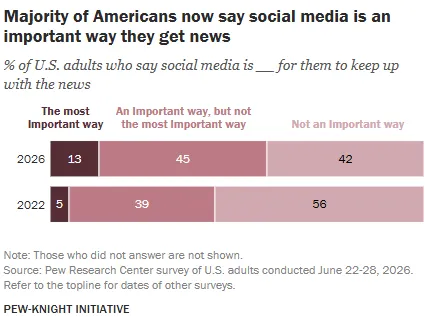
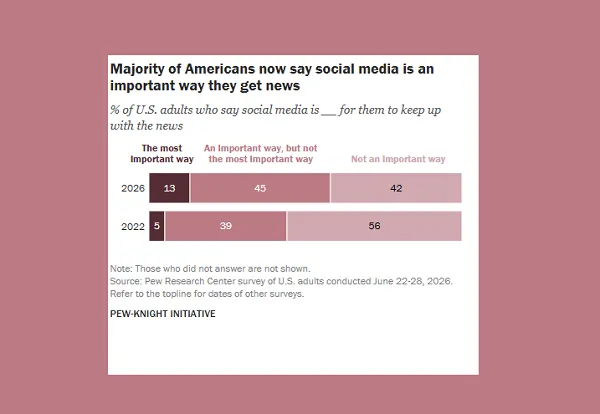
As proven on this chart, 58% of People contemplate social media to be an essential connector to present occasions. Inside that, 13% of People contemplate social apps to be their most essential info supply. Based mostly on the complete U.S. grownup inhabitants of about 270 million, as estimated by the Annie E. Casey Basis, that implies that round 35 million U.S. adults now depend on social media to maintain them knowledgeable.
That’s increased than when Pew Analysis performed the identical analysis in 2022. In that report, as cited within the above chart, 43% of U.S. adults mentioned social media was an essential method that they acquired information, whereas solely 5% mentioned that it was a very powerful information useful resource.
As famous, the info underlines the rising reliance on social platforms, whereas additionally additional underlining the facility that social networks must affect media narratives, relying on every app’s coverage and moderation strategy.
That’s been a key level of rivalry for a while. Elon Musk, for instance, bought Twitter in 2022 based mostly partly on his personal issues that the Twitter administration staff had been interfering with democracy by manipulating what posts gained traction within the app.
The sort of hypothesis has coalesced into what some have known as the “censorship industrial complicated,” which is allegedly a free assortment of activists that has sought to police on-line conduct by trying to sway public discourse by way of crackdowns on speech, and making an attempt to restrict what may be amplified inside social media apps.
Certainly, in December U.S. Secretary of State Marco Rubio introduced that the State Division was taking motion in opposition to people whom it claimed had led organized efforts “to coerce American platforms to censor, demonetize, and suppress American viewpoints they oppose.” That announcement was titled “Actions to fight the censorship-industrial complicated.”
Given the affect that social media platforms now have, it is sensible that the federal government desires to make sure that they continue to be free and open to all views. But, on the identical time, permitting info to circulation by way of these platforms, enabling probably big amplification of any claims, can facilitate the unfold of misinformation and false narratives.
As such, it’s essential to contemplate the position that social platforms ought to play in establishing the foundations round what folks can and can’t say, and who must be making these calls.
The platforms themselves have been eager to take a extra hands-off position on this entrance, and permit customers to dictate what’s acceptable and what’s not. However once more, given the numerous affect that social platforms have on the circulation of reports and knowledge, that might set a harmful precedent. As well as, platform algorithms are designed to spice up conversations that drive extra engagement, no matter what these particular claims and conversations could also be, which usually results in essentially the most controversial discussions getting extra publicity.
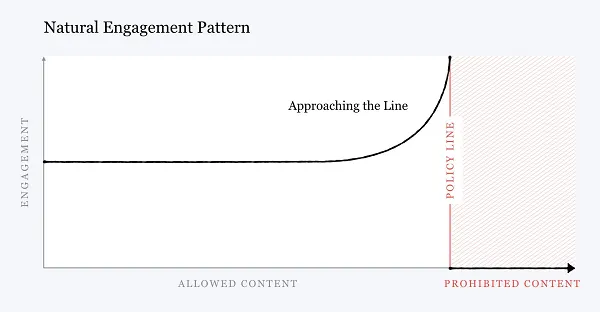
The idea that individuals will at all times have interaction extra with borderline content material was outlined by Meta founder Mark Zuckerberg in 2021, in a submit through which he argued that extra must be carried out to handle makes an attempt to weaponize misinformation.
As per Zuckerberg: “One of many greatest points social networks face is that, when left unchecked, folks will have interaction disproportionately with extra sensationalist and provocative content material. This isn’t a brand new phenomenon. It’s widespread on cable information in the present day and has been a staple of tabloids for greater than a century. At scale it may undermine the standard of public discourse and result in polarization.”
And but, in January 2025, Zuckerberg modified his tone. In a submit about Meta’s transfer away from fact-checking, he argued that the corporate has an obligation to permit extra speech, and facilitate extra dialogue on borderline subjects. Because of this, Meta then relaxed a few of its guidelines that had beforehand restricted the dialogue of sure controversial subjects, together with immigration and gender identification.
By Zuckerberg’s personal logic, this shift will result in extra polarization, which can lead to extra hurt.
It’s a big change in perspective, and as social media platforms develop into much more vital sources of knowledge, it begs the query of why Zuckerberg had a change of coronary heart on this, and determined to go the other method permitting extra of this dialogue, regardless of acknowledging potential hurt.

